Category Archives: inspiration

Discouragement

There are few things I find more depressing than a teacher discouraging a student. It doesn’t matter what level, students should never feel that a teacher doesn’t believe in him or her. Unfortunately, teachers like this exist at every level. I found myself thinking about this recently when I came across one such teacher, now retired, in my daily life. I never had her as a teacher, but she always seemed to go out of her way to be negative. I occasionally see this women in my business life, and she well knows that I went back to school to become a teacher. It never fails: She always brings it up and always acts as though I will never find a full-time teaching job. Excuse me? Neither one of us knows what will happen. Thanks for the vote of confidence.

The worst is overhearing negative teachers talk. One woman bluntly stated that she would pay for her children’s college educations in full, as long as they did not become teachers. I didn’t say anything, but that statement didn’t sit well with me. If that teacher happened to have my child as a student, there might be cause for concern (frankly, I am being nice here).

Even as a high school student, I went out of my way to avoid such teachers if I could help it. I knew of one teacher who had years earlier discouraged my aunt from pursuing her chosen profession. He didn’t particularly like my family. Fortunately, my aunt didn’t listen to him and went on to have a successful career in her chosen field. Well, for whatever reason, he must not have made the connection that I am related. I had to have him for one class, and it was OK. However, I did have a choice as to what I could take as a senior. Even though most of my peers took an additional class with him, I chose a different class. I am so glad I did. The last thing I have ever needed in my life is someone to tell me that I can’t do something. I am already my own worst critic, and I know that I am not the only one.

How many students have been discouraged from trying something new due to an overly critical teacher or parent? What a sobering thought. I am convinced that everyone has innate talents; some people just haven’t discovered theirs yet. Imagine if we were all a little more supportive and a little less critical of those around us. What a wonderful thought. So many of our biggest, toughest problems might actually be solved. Maybe people wouldn’t turn to drugs and alcohol quite so easily if they felt what they did mattered, that they could contribute to society.

This actually gets to the heart of what I believe to be wrong with society. We are too hung up on perfection. We don’t value ingenuity. We don’t honor work ethic the way we should. We don’t honor true diversity of talent. Well, I guess I’ll leave it there.
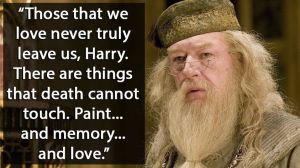
Harry Potter and the Cursed Child

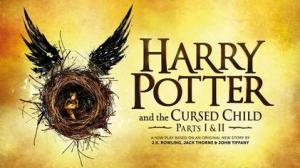
Several months ago now, my book club decided to read Harry Potter and the Cursed Child. There was only one problem: I had never read the original series. When the books originally debuted, I was already in high school and then college. I’d already fallen in love with what I considered to be more important literary fiction. I simply didn’t have time for what I considered to be a mere series of children’s books. The thing is that I’ve never been a reader of fantasy or science-fiction, although that is changing. I often wonder if it might have been different without the elements of magic and fantasy; maybe I would have come to the series much earlier.

In the end, Harry Potter and the Cursed Child became my catalyst to finally read the Harry Potter series. I am still in the process of reading the entire series, but two things have become increasingly clear:

1. My idea to have a protagonist of a children’s book series grow and develop throughout the series is a valid one. This entire subject deserves its own blog post soon.

2. There is simply no way I could not read the entire series, not if I want to write a series of children’s books, whether they are eventually published or not.

Even though I had only read the first two books in the series prior to reading Harry Potter and the Cursed Child, it was enough to get a sense of the series and the characters. What I loved about Harry Potter and the Cursed Child is what it says about parenthood. In the play, and it is written as a play, both Harry and Draco Malfoy struggle as fathers. Both seem eager to help their sons avoid the pitfalls of their own childhoods. The problem is that Harry’s son Albus is not the famous Harry Potter, nor is Draco’s son Scorpius exactly like him. As a result, neither father can ultimately protect his son from evil. Even though I am not yet a parent, it made me realize that one cannot base parenting solely on their own experience. Biological or not, your child is not exactly like you. He or she may be nothing like you. It is interesting to me that one of my first introductions to the world of Harry Potter took place when Harry, Ron, and Hermione were adults – and parents. I love the fact that they are supposed to be roughly my age, and if one follows the timeline during which J.K Rowling wrote the books, it works.

Frankly, if I am completely honest with myself, I cannot wait to read the Harry Potter series with my child(ren) one day, along with so many other books. Will I force it? Of course not, but I will at least try. I’ll be happy if my child(ren) finds a genre he or she (or they) love(s). I do think it is true that people who don’t like to read just haven’t found the right books yet.

The Things We Love

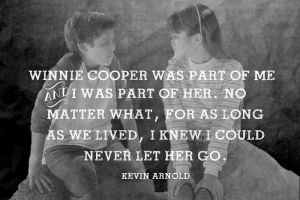
Before there was Harry, Ron, and Hermione, there was Kevin, Paul, and Winnie. For whatever reason, and I have my theories, I adored The Wonder Years as a kid. Let’s face it: I wanted to be Winnie Cooper. I wanted to look exactly like her; however, I hoped that I would not be quite so critical and whiny (cue any time she said Kevin’s name). There is just something about the entire series that always stuck with me. Maybe it had something to do with this: Quotes from The Wonder Years. If nothing else, the writing is fantastic. Not that long ago, someone brought up how artificial and inauthentic the late 1960s and 1970s could be. That statement did not sit well with me, and I finally figured out why. One of what I consider to be the most authentic TV shows happened to be set in that exact time period. I understood where he was going with that statement, but it didn’t tell the whole story. Did the late 1960s and 1970s have kitschy moments? Of course it did, loads of them (the clothes alone …), but that wasn’t the everyday experience of most people who lived during that time period. I refuse to believe people are that shallow.

The irony is that if a “modern” version of The Wonder Years was made today, it would be set in the 1990s. From what I remember, most of the story lines wouldn’t have to change much. It would still be possible to deal with middle school/high school crushes, friendship, politics, learning how to drive, and first jobs. Only the historical backdrop, clothes, and music would have to change. As much as I would love to see that happen, it would not be the same. Such a series could only be viewed in the shadow of The Wonder Years.

All of this left me wondering why we love what we love. Why do we love the people we love? Do we really have a choice? I’m not sure. I’m even less certain as to why we fall in love with certain things. Why do we connect with certain music, books, TV shows, and movies, while not caring for others? I have no idea. I do know that I love the movie Casablanca and the ending scene of Bridget Jones’ Diary. I love the characters of Mr. Darcy: Both Fitzwilliam Darcy of Pride and Prejudice and Mark Darcy of Bridget Jones’ Diary. The ending of Six Feet Under is one of the best endings of a TV series I’ve ever come across. Francine Prose’s Reading Like A Writer continues to influence me as a writer and inspired me to read her other works. It completely changed how I read. I refuse to watch anything after the last episode of the third season of Call the Midwife because of how nicely it summed up the series to that point. The adoption scene with Dr. Turner and Shelagh gets to me every time. I could go on. All of these things influence what I read, what I watch, and eventually, what I write. Maybe we don’t find the right material, maybe the right material finds us. As for people, well … one can hope.