I do not want to turn this into a political discussion, but world events over the last several weeks have only served to underscore how we are watching history unfold daily at this point. First, Venezuela. A young Venezuelan business student became one of the first students I met in the Eli Broad College of Business at Michigan State. In fact, I may have met her at the Broad Business Student Camp I attended the summer before my senior year of high school. Sadly, after all of these decades, I cannot remember her name. Prior to meeting her, I didn’t know or realize that in the late 1990s, Venezuela had one of the most developed economies in all of Latin America. All thanks to oil, of course. I do remember that she was about to graduate and head home. As Venezuela fell under Chavez’s dictatorship and became a Communist country, I often thought of her and the Venezuelan people. What happened to the future she planned during her time at Michigan State?
After Maduro’s downfall a few weeks ago, I can’t help but continue to watch Facebook Reels and Tiktoks of the Venezuelan people celebrating and praying for a bright future for Venezuela. So many left years ago. So many families separated for decades. I can’t begin to understand what they have been through the last 25 years. I pray that it will soon come to an end.
And now, Iran. To put things into perspective, Iran has been under the control of Ayatollah Khomeini since before I was born. Even though the hostages were taken nearly a year before I was born, they were still in the news when I finally arrived. It would take another month for them to finally be freed. Most people don’t realize what Iran was like before it became a brutal theocracy oppressing all until its control, especially women. Research it for yourself. It is eye-opening. Some seem to forget this, but A Handmaid’s Tale is partly inspired by the oppression of women in Iran (much more to come on that topic at a later date). Prior to the revolution, women were not segregated from men in public. They were not in theory or legally property of their husbands or nearest male relatives. There were no requirements to wear a hijab or simply fade into the background of society. Women fully participated in society.
Over the last couple of days, I’ve been watching Reels and TikToks, impassioned pleas from Iranian-Americans, extremely grateful for the fall of Kholmeini. The descriptions of what their relatives have endured in recent history, particularly over the last few months, is heart wrenching. I’ve watched an Iranian-American woman describe how their mom group chats here in the US detail the logistics of school and sporting events, while their sister mothers in Iran debate the risk and daily terror of sending their children to school at all. Another woman described how she wished her grandmother was alive to see this. In 1980, her grandmother was jailed, raped, and tortured by the regime, all for being an artist. I never dreamed that I would see the day when Iranian-Americans would take to the streets of Los Angeles to celebrate the fall of the Iranian government. Think about that and what a powerful statement that is.
I will never understand how people can condemn these actions. Do they not see the decades of suffering? Do they not see the oppression? Do they not see how governments such as Iran destabilize everything? If you don’t believe me, take a look at how much support the US has from other countries in the Middle East. This isn’t Vietnam. This isn’t Iraq.
I’ve tried to blog countless times since school started this fall, and well, if I am honest, I’ve felt overwhelmed ever since Charlie Kirk’s tragic death. There still are no words. No matter what I have to say, all I could think of is that it could potentially add to the hate, and that would never be my intention. It isn’t that I didn’t or don’t have anything to say. No. Quite the opposite. I have so much to say that I didn’t know where to begin. Sometimes, it just comes to you. Sometimes, you just have to start again.
On rare days as a teacher you may have small wins. Sometimes a lesson goes particularly well; it may finally “click” for that student you’ve been worried about all school year. A small victory in the grand scheme of things, but invaluable when you truly care. It is the same with writing. There are times where you just have to get it down before it is gone forever. It may not be perfect, but there is a kernel of truth in there somewhere. On the rarest of rare occasions, both happen on the same day within the hour. That was my day today, but first, a little background.
My dream of creating a creative writing club for my students may have started during my years teaching middle school at St. Mike’s, but I had no idea where it would lead. At St. Mike’s, my teacher bestie Dorri and I teamed up to form a group for students grades 3-8 interested in writing. We were small but mighty – and we even survived a pandemic. I wish others could have witnessed the patience that my middle schoolers had with Dorri’s budding 3rd grade authors. Dorri and I may no longer teach together, but we still bring up the magic that happened during writing club. In fact, this fall, I learned that one of my former students, one of those patient middle schoolers now a high school senior, will soon have a short story published in an anthology. He couldn’t be more deserving or have a brighter future.
Last year, my first year as a full-fledged teacher at Michigan Virtual Charter Academy (MVCA) teaching 10th grade high school English, I knew that I wanted to try again. I wanted to create a creative writing club for our high school. Throughout the school year, we became a tight knit group of writers who wholeheartedly supported one another. I hated to see it end. This year, I didn’t know if I could create that atmosphere twice.
Fortunately, I did. Even though I have an almost entirely new group of students this year, they are just as supportive and passionate about writing. Above all, they are wonderful writers. In fact, in addition to sharing what I wrote today during our session, I wish I could share some of my students’ work as well. They are far more talented than I ever was during my high school years. It is beautiful to see and gives me so much hope for the future. Gen Z – and what I’ve witnessed of Gen Alpha – are far more compassionate and understanding than the Gen Xers, Xennials, and Millennials I grew up with. They seem to grasp just how much damage mere words can do. They also understand that there is more to life than work, image, and material things.
So, I decided to share with you what I wrote today in the span of twenty minutes. It is not perfect, but it is a start. There is something there. In that same twenty minutes, one of my students created a piece so wonderful that it is begging to be shared. I am hoping to get at least a paragraph of her work in the yearbook. Yes, 2026 is off to a great start. Today was a good day.
Why I Write …
I write to not be forgotten.
I write to calm the storm and slow down time.
I write to express and gather my thoughts and ideas.
I write to make sense of the chaos trying to drown me.
To create order out of chaos.
I write to explain the inexplicable.
I write to support and inspire others.
I write to find meaning where there is none.
I write to remember what shouldn’t be forgotten.
To capture what could be lost, what shouldn’t be lost.
I write to learn and study.
I write to make connections and share with others.
I write to expand my understanding of everything around me.
I write to learn how to teach others to write, wonder, and explore.
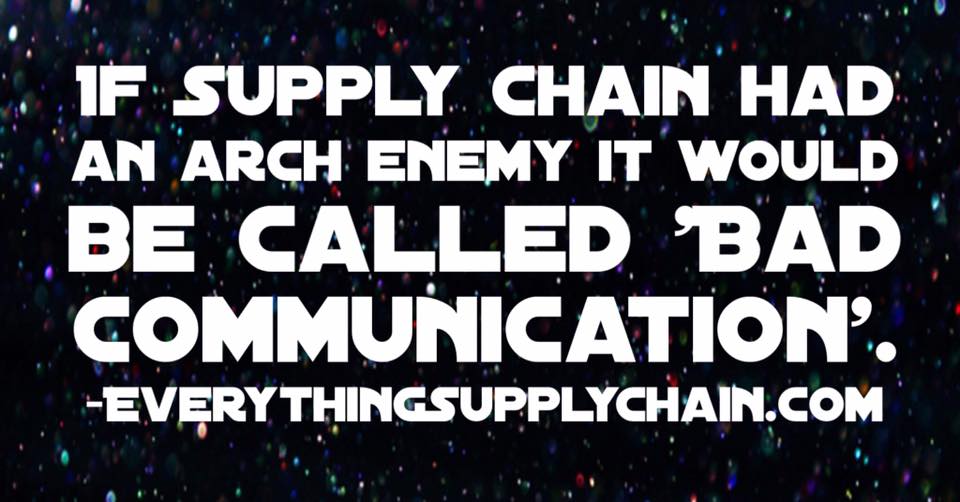
Little known fact: The US military is the largest supply chain in the world.
My supply chain management education will always color the way I view things. At times, I wish it didn’t. In education, I like to believe that most students will find their way, eventually. Most will find their purpose. I feel for those who don’t, but it is a reality of life. There are always those who remain lost, and sadly, I’ve known a few. I can help, but I can’t be everything to everyone.
With supply chain issues, there is a solution. There is always a solution. We just need the resolve to follow through and make necessary changes. We learned so many supply chain and economic lessons from the Greatest Generation and World War II, but as that generation passed away, I fear that we have lost those lessons or even ignored them completely.
Let me start at the beginning. I am deeply proud to come from a long line of entrepreneurs. I long idolized my dad and Grandpa Buttrick. Both owned and ran their own companies and were self-employed, as different as their companies were and still are. My dad developed Russell Canoe Livery around our family and our lifestyle. He had no desire to build it beyond what it is now, even if we had the opportunity.
Grandpa, on the other hand, loved to build. He expanded his convenience store business into screen printing, Subway franchises, propane, hotels, and more. He even loved to compete against himself from time to time. As a child who loved to build, I took notice. In having the opportunity to manage one of his convenience stores for a few years, I am grateful to have learned just why Grandpa loved the c-store business so much. Ultimately, it helped me become a better manager at the canoe livery and a more empathetic boss.
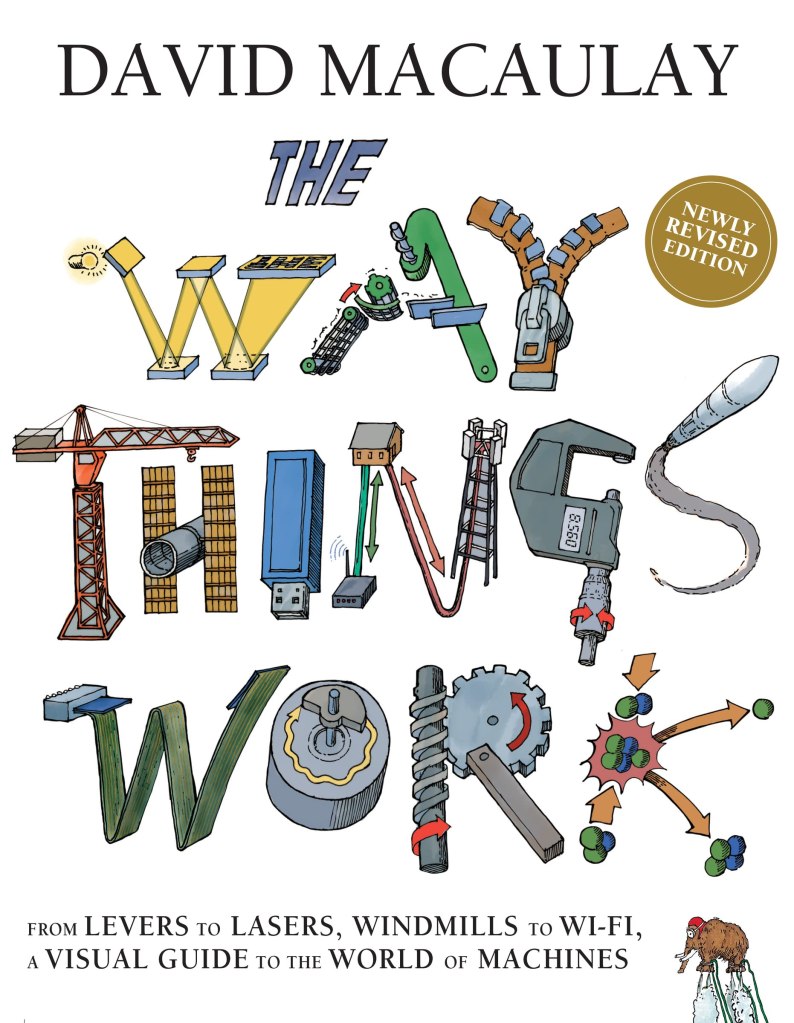
While this cover is exactly how I remember it, it must be an updated version! No WI-Fi in the 80s and 90s!
As a child, one of the most fascinating books I owned was The Way Things Work by David Macaulay. I wanted to know how and why things worked. Looking back, this helps explain why I chose supply chain. It fit the bill. I knew I didn’t want to study management. I wanted to know exactly how value was added, and not just become increasingly removed from day-to-day operations that actually pay the bills. Accounting and finance never even entered the picture. In fact, my mom and I joke that we would starve if we had to try and make a living as accountants. I am decent at math, but I make errors far too often, and it is not my thing.
I do have two older cousins who earned supply chain degrees from Michigan State and blazed the trail, but as my older cousin Emily tried to sell me on supply chain, it made me look at the program more critically. Instead, my experiences at the Broad Business Student Camp (BBSC) after my junior year of high school sold me on Michigan State and supply chain management. During that week attending BBSC, I had the opportunity to explore State’s incomparable campus, everything the Eli Broad College of Business had to offer, as well as all things supply chain. In short, I had the opportunity to preview what my life would be like as a Michigan State business student with one of my best friends. What was not to like? By the time my parents dropped me off at MSU in August of 1999, I had to kick them out of my dorm room as I had already connected with student groups in the business school, and I was not going to be late for the first meeting.
Now you know why I never wavered in my pursuit of my supply chain degree, in spite of the fact that, deep down, I knew that I wanted to be a teacher as well. As for the deeper lessons that stayed with me and kept me up at night, it all started with a business history class I took during the winter of 2000, the very heights of the dot.com bubble. In fact, the bubble burst that consumed that spring forced me to pay attention. My history professor, in fact, predicted the fall of the stock market (the dot.com bubble) publicly almost as soon as classes started in January. When it finally happened in March, as a 19 year old, it left a deep impression. However, as memorable as that experience was, this is not primarily why I remember this class 25 years later.
Instead, my professor’s description and explanation of how Detroit became the “arsenal of democracy” still sends shivers down my spine. He made the case that the United States and the Allies would not have won World War II without Detroit. While I knew Detroit played an important part in the war, I didn’t realize just how important. Supposedly, when Hitler received intelligence of manufacturing totals coming out of Detroit, he didn’t believe it. Those who had gained manufacturing experience in cities like Detroit, especially Detroit, would turn their focus to the war effort.
When you think of the manufacturing capability we had during that time, the early 20th century, it makes sense. We were able to help supply Great Britain long before we officially entered the war after Pearl Harbor. Thanks to FDR, we switched from manufacturing consumer goods to munitions. We went from cars and refrigerators to tanks and aircraft. This is the question that keeps me up at night: Would we be able to do so again if faced with such a crisis? I don’t know.
Actually, I doubt it, as the way things are now. Born at the end of 1980, I’ve watched my entire life as Michigan lived up to its “rust belt” image. Most of the business professionals I graduated with in 2004, me included, had to relocate to states such as Texas and California to find jobs. When my parents graduated from college in the late 70s, there were still good manufacturing jobs to be had right out of high school, although that would soon come to an end. I grew up hearing of plant closures, manufacturing outsourcing, and general loss of manufacturing capability in the United States. It is all I knew. By the time I sought to start my career, little remained. Instead, less secure positions with multinationals outsourcing much of their labor to places like China, Mexico, and India took their place, particularly in the shadow of the first dot.com bust.
By the time I interned with IBM out in Rochester, Minnesota during the summer of 2001, not only did they not have enough for their interns to do, their full-time, permanent employees didn’t either. Instead, they were focusing on their garage bands and updating their resumes. In 2003, as part of a tour of a GM factory in Mexico near the border, I vividly remember seeing rows upon rows upon rows of brand new Pontiac Azteks and Buick Rendezvous awaiting shipment as our chartered bus slowly approached the plant. Looking back, it foreshadowed Pontiacs epic downfall several years later. Tragically, Pontiac would never recover from the monstrosity that was the Pontiac Aztek.
My last semester at Michigan State in 2004 brought the Eli Broad College of Business’s first Chinese Supply Chain Symposium. Of course, it focused on all of the wonderful benefits of outsourcing manufacturing to China. I left wondering if I was the only one asking just how long before we were outsourcing our own jobs? Where and when would it end? Was I the only one seeing the connection between outsourcing and both unemployment and underemployment in the United States?
Even Russell Canoe Livery has a supply chain, one with its own set of challenges and setbacks.
I will leave you with this summary. We desperately need to bring manufacturing back to this country. If you think the supply chain interruptions during the COVID 19 pandemic were bad (and I followed them closely), what would happen in the case of an even worse global crisis? Good manufacturing jobs helped finance the growth of the middle class throughout most of the 20th century, particularly after World War II. Why can’t we get back there? We’ve learned so much during that time, and we have the workforce, if given a chance. I hope I live to see it. By the way, this doesn’t mean becoming isolationist. It is simply expanding beyond the pharmaceutical, technology, and service industries. Supporting local farms wouldn’t hurt either! Cheap is good, but it is not always best in the long-run. We’ve remained far too short-sighted and complacent for far too long.
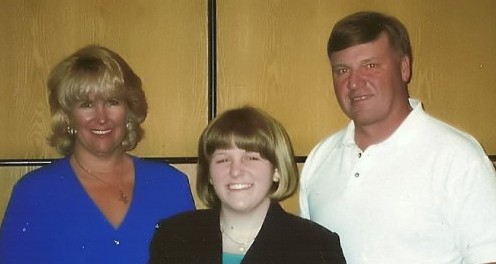
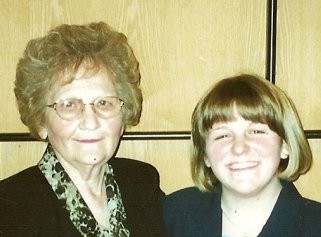
Mom, Dad, and I – MSU Spring 2001Grandma Reid and I – MSU Spring 2001 – One of the best business women I’ve ever known!
Mom, Dad, and I – Spring 2001 Tower Guard Induction – Beaumont Tower, Michigan State University
In honor of Grandma Reid, who worked as a riveter in both Hamtramck, MI and Fort Worth, TX during the World War II era, all before the age of 20.
One of my biggest projects this school year – so far – is to establish a creative writing club for our high school. I started with a vision and my previous experience of working with my teacher bestie, Dorri, to start a writing club at my previous school. To say that I learned from that experience is an understatement.
In that club Dorri and I worked to establish at St. Michael School, we dealt with technology issues, age differences (serving young middle grade students as well as middle school students), not to mention the hazards of the COVID 19 pandemic. It is crazy to think that we achieved anything at all. Yet, we did in a small way, even if the larger St. Michael community didn’t always recognize it.
We may have had a small core of roughly half a dozen students, but they were truly interested. They eagerly learned from one another. My 7th and 8th students demonstrated patience with Dorri’s 3rd graders, many of whom were just learning how to more fully express themselves in writing, expanding their thinking along with their vocabulary. Dorri’s 3rd graders brought enthusiasm and fresh perspectives to their older peers’ projects.
When I started at Michigan Virtual Charter Academy this past fall, I knew that I wanted to become involved in some kind of club. While I knew that we had a well-developed esports program, I didn’t exactly know what other clubs were offered. It turned out that while we offer an academic creative writing class, we did not have a creative writing club. Well, I sought to change that. So far, I have succeeded.
At the beginning of the school year, I focused on creating an online classroom full of resources I could have only dreamed of as a high school student in love with writing. There are dozens of websites to explore, hundreds of writing prompts, inspiring quotes, book recommendations, and so much more. Then, I watched over several weeks as my students connected and explored common interests. They grew as writers and found the confidence to share their work and a little bit about themselves. Students then spent much of the semester writing pieces intended for eventual publication, likely a blog. What happened next, I did not see coming.
We may have to wait until next school year to publish anything, but not only are both the principal and assistant principal extremely supportive, our head of school now knows about the project. In fact, I’ve received nothing but positive feedback. Right now, I am working on helping to ensure we keep moving ahead in the right direction. Who knows where this will take us? Already, I have had two new club members join in the first few weeks of this new semester. They’ve fit in seamlessly, which is a testament to the culture my students created. I am incredibly proud of what they’ve achieved!
I did not set out to become a teacher, I left that to my younger sister Erica. As her older sister, I’ve never known her to want to be anything other than a teacher and a mother. I envied the fact that she was so certain about her desired profession, not to mention her dedication to her love of children. When we played school – and we did often – I ended up being the school librarian while she insisted on being the teacher. Until our younger brother was born when I was age 10 and Erica age 7, we didn’t have a single pupil. By the time he was two, Erica made our toddler brother a series of report cards, grading him on things like “listening” and “sitting still.” But, this isn’t my sister’s story. It is mine.
My story of pursuing a career as a secondary teacher is by no means conventional. In fact, it is so unconventional and challenging that I would recommend it to no one. If it weren’t for the facts that teaching is in my DNA and I am meant to be a teacher, I would have given up long, long ago. Instead, I doubled-down when I was faced with what at the time seemed to be insurmountable obstacles. I even went back to substitute teaching when needed while deciding what my next step would be. I am a better person, and teacher, for it.
Every story needs to start somewhere, and mine starts with the statement that teaching is in my blood. It truly is. As a genealogist, as far as I can tell, the teaching tradition goes back at least five generations on my mom’s side of the family. It likely goes back even further. Both of Mom’s grandmothers taught, and one of her grandfathers served as principal of his daughters’ elementary school, as well as coach.
Interestingly, the teaching careers of my great-grandmothers could not have been more different. I knew both Grammy Bea (Beatrice Williams), who taught kindergarten and first grade for decades at the height of the baby boom, and Great (Leona Buttrick), who taught in a one-room schoolhouse and quit teaching once she married my great-grandfather Hatley. Although these are stories for another time, their careers illustrate massive changes in public education.
Funnily enough, the teaching tradition isn’t exactly confined to mom’s side of the family. Even though neither of my dad’s parents had the opportunity to further their education, they highly encouraged their children to do so. Both did, and even though my dad and his sister didn’t necessarily see eye-to-eye on much of anything, I find it telling that they both married teachers. On the Suszko side of Dad’s family, there are several special education and agricultural teachers. In fact, my cousin Kristy, a woman with whom I attended school at all levels from kindergarten to college, now teaches dairy science at the university level.
As much as I did not want to admit it, I am a teacher. It took me far too long to make peace with that fact. Something inside me would not let it go. As soon as I graduated from Michigan State in 2004 with degrees in supply chain management and Spanish, my entire world shifted. It would not be made right again until I went back to school in 2013.
It all started during the Great Recession with a casual conversation with my ex’s mom Cindy. We were invited to dinner as usual, and Cindy and I struck up a conversation. She told me that she wished that she’d gone back to school to become a nurse. All I could think at the time was that I did not want to be in my 50s and regret not pursuing an interest. During the Christmas shopping season of 2008, I worked at Best Buy in Saginaw. As I lived in the South End of Bay City at the time, I drove by Saginaw Valley State University (SVSU) every day on my way to work. Slowly, I started to wonder what would happen if I did decide to go back to school to become a teacher. The idea excited me and fed my imagination. How could I make it happen? How would I adjust? Online classes, in their infancy back in 2004, intimidated me.
Eventually, I had the ability to make it happen in 2013. I largely enjoyed my time at Saginaw Valley State University (SVSU), although I would advise commuter students to do their homework. For example, if I had not followed up with my advisor, I would have stressed out about the math portion of the general MTTC exam necessary to even apply to the College of Education. I didn’t necessarily doubt my ability to do higher-level math likely trigonometry and low-level calculus, but I had not remotely touched those subjects in well over a decade. The thought terrified me. Much to my relief, my counselor informed me that I scored high enough on the ACT test I took in high school that I did not need to take the general MTTC at all. I then questioned why I wasn’t informed earlier. She simply stated that it likely stemmed from the fact that I was a commuter and a non-traditional student. While I would highly recommend SVSU to traditional college students coming right from high school, I’m not so sure in other situations.
I enjoyed most of my classes and professors at both Delta College and SVSU, but I can’t say that I didn’t have any bad experiences. In fact, one professor and class at SVSU stands out for all of the wrong reasons. This particular professor taught a class that focused on diversity. However, somehow, throughout the entire semester, he managed to offend nearly everyone in the class. Horribly. He supposedly hated coaches. When I ran into a former classmate in a school setting years later, we naturally discussed this infamous class and professor. This man, who happened to coach as well as teach, informed me that this professor tried to get him removed from the College of Education program, likely because he planned to coach.
Somehow, this professor appeared to have no issue with me or one of my good friends, even though he had long ago deeply offended us both. As we paired up to complete our main teaching project for the course, things fell apart. When it came time to “teach” our project, our professor respected my teaching time and even seemed pleased. Then, he proceeded to continually interrupt my friend and teaching partner for her entire portion of the project. He made it exceedingly difficult for her to even finish. Already extraordinarily introverted, I have no idea how she made it through. Disrespectful doesn’t even begin to cover it. Unfortunately, she never did become a teacher, although she would have been wonderful. Instead, she became a librarian. To this day, I still believe that the world needs introverted teachers too. There are too many people like this professor that discourage future teachers every step of the way before they even get started.
Stay tuned … There is much more to this story.
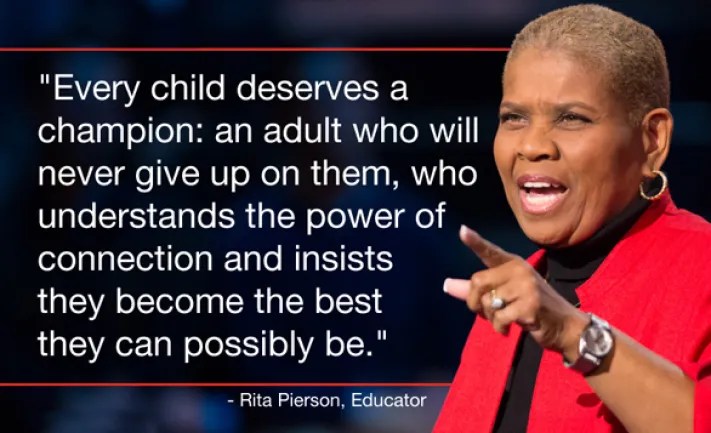
Not just my favorite TED Talk on education and teaching, my favorite TED Talk period.
I love it! I finally took the time to clean out my Goodreads account. I’ve had an account for well over a decade (possibly even close to two), but I have rarely used it to keep track of my reading or anything else. When I first joined, I started to use it to catalog my books. At the time, torn between Goodreads and LibraryThing, I didn’t realize that both websites were created with very different intentions. Goodreads aims to connect readers, help readers keep track of their reading, and serve as a true social media platform for readers. LibraryThing, on the other hand, is meant to help people catalog their book collections. They have also cataloged famous personal libraries and annually hosts one of my favorite Christmas traditions – SantaThing. Basically, SantaThing is similar to a secret santa for book lovers. Participants chose the amount they would like to spend. Then, participants choose books for another person while someone else chooses books for them. I have yet to be disappointed!
After several years of trying to decide how I want to go about tracking my reading, I have finally settled on Goodreads. You can find my Goodreads profile here. The wonderful thing is that a large part of my family is going along for the ride. Several of my aunts are avid readers, as are my new brother-in-law, his daughter, my sister, my sister-in-law, and my mom. We now have quite a crew and have already spent some time sharing book recommendations with one another. My Grandma Buttrick would be incredibly proud!
In fact, I’ve been meaning to brag about this here, but my grandma proved to be way ahead of her time. In the late 80s and throughout the 90s, Grandma Buttrick helped to establish an early version of a free little library. During that time, she always seemed to have a box of books to take/donate to the hotel in her garage. At the former Quality Inn in West Branch, a continued important part of Forward Corporation (Grandpa was president at the time, and later, served as chairman of the board), Grandma kept a rotating paperback rack full of books for hotel guests. Sitting in the lobby in an alcove near the registration desk, guests could take or leave a book. I wish I could tell her just how ahead of her time she was. I like to think that she’d be incredibly pleased to see how we’ve passed her love of reading down the generations. Our little book club of two lives on!
As a child, Grandma Buttrick was the one who helped me get my first library card in Standish. I’ve done the same with my niece and nephew. I do hope that our excursions to the library leave an impression on them. If anyone out there continues to believe that libraries are no longer relevant, they need to actually visit one!
I just found out today is National Author’s Day. How appropriate! The creative writing club I started at school met this afternoon at the end of the school day. There is never a dull meeting. They are so passionate about their interests, including but not limited to writing. I’ve watched as members have bonded over music and other media. It is inspiring how they support one another, too.
In the online school environment, there aren’t quite as many opportunities to strike up friendships with classmates as in brick and mortar. Personally, I think that is why school clubs are so vital in an online school environment. Last year, my first year teaching online, I watched as students planned for weeks and even months for the in-person prom held at the Lansing Center. Students attended from all over Michigan. The pictures, conversations, and friendships made that evening were discussed repeatedly as the school year came to a close. I can only hope that that same can be said when I reflect on the creative writing club at the end of the school year.
In my first year as mentor and creator of the club, I sought to find the best possible resources for aspiring high school writers. Luckily, my online classroom set aside for our new club allowed me to do just that. It is now a place where students can collaborate, offer one another and seek encouragement, as well as find resources and inspiration. I can only imagine if I had had such a resource in high school. I admit, I’ve had too much fun setting things up. So far, my entire experience with the creative writing club has underscored the importance of community as a writer.
Face it: Writing can be lonely work. Over the years, I’ve always enjoyed meeting other writers. I can’t imagine where I’d be as a writer without Mid-Michigan Writers. I’ve learned so much from other members over the years, and I would not have discovered Delta College’s general writing certificate program if I hadn’t attended MMW’s Gateway to Writing workshop with other writers who raved about the experience. If my students take away anything from our creative writing club, I do hope that they realize the importance of community for writers. Brainstorming works best with others! At some point, we could all use a second opinion. We all have to learn from someone. I can’t imagine not having my very own community of writers and readers. Happy National Author’s Day!
I don’t understand. I adore writing, and I have no shortage of material. In fact, I came across my blogging notebook today. Page after page full of great ideas I have not yet written. I also came across another binder of writing projects, as well as my writing portfolio from one of my favorite writing classes, a class I took at Delta College nearly a decade ago. What to do with it all? It is time to bring it all together. Why is it so difficult for me to write consistently for long stretches of time? Why did I abandon poetry again? I came across some wonderful pieces. Pieces that need a home.
Then there are the larger projects. Mom and I need to finish her series of children’s board books, abandoned nearly nine years ago. I still love them. Over the last several years, I’ve toyed around with the idea of writing a book about the canoe livery. It is time to put in the research. I need to interview my parents and former employees before it is too late. I do not want those stories to be lost, even if they are never published. There are simply too many good ones.
So, what is getting in the way? Quite simply, life. Accepting a position as a 10th grade English teacher at Michigan Virtual Charter Academy (MVCA) back in August, I’ve been busy. While I subbed at MCVA most of last school year, I am now a full-fledged faculty member who hadn’t yet experienced the start of the school year – and all that brings (I started in early October last year). In other words, I’m now getting back to finding time to write. Just because you have prepared for a new school year in a brick and mortar school does not mean that you know the ins and outs of preparing for a new school year at a virtual school.
One highlight of the school year is creating an official high school creative writing club. I am passionate about it. So far, I’ve been able to create a safe online space for students interested in creative writing. As a club, there are no academic expectations. We are writing for the sheer creative power of it. By the way, MVCA offers a creative writing course as well. This … this is something different, something special.
Thus far, I’ve curated websites that might help budding high school creative writers. I’ve also shared my favorite quotes and books on writing. There is space for students to share their work amongst themselves. I can’t imagine what I would’ve done with those resources, all online and free, and such a nurturing community. The best part is the enthusiasm of my students. I’ve watched them form fast friendships over favorite music, video games, books, movies, and more. They are so supportive of one another. I can’t wait to see all that we will accomplish this year. That includes getting back to my own writing.
July 1984 – Tawas, Michigan – Hamming it up with my Schneider and McTaggart cousins at Aunt Tara and Uncle Bill’s wedding. Thank you Aunt Amy for helping me locate this picture!
Sometimes, a picture can bring up a wide-range of emotions: joy, sadness, nostalgia, and everything else. Earlier this summer, I sent my aunts on a search for the picture above. It had been on my mind for some time. I consider it one of the definitive photos of my childhood; one that has always stood out. First, Grandma Buttrick had it framed in one of the back bedrooms of her house for many years. I always enjoyed coming across it during visits. For that reason alone, the picture remains a favorite.
While I was too young to remember having the picture taken at my Aunt Tara’s wedding to Uncle Bill in July of 1984, I grew up hearing all about it. I can’t tell you how many times I heard the story of how I, at three years old, took the instruction to smile at everyone as a flower girl walking down the aisle much too literally. I stopped at every pew. At the end of the ceremony, I cried and ran after my mom as she left the church in the processional as a bridesmaid. I didn’t understand that I just needed to follow my older cousins. My only memory from that day is a hazy notion of playing at the beach on the animal-shaped play equipment at the Tawas City park during the reception.
July 1984 – Smiling for the camera right after the ceremony … Thank you to Aunt Tara for locating this gem.
In the picture, I see myself as a little girl full of personality and character. There is no doubt that I was a ham like my mom, an extrovert. When I look at this picture, I see “before.” Before self-doubt, before losing self-confidence, before I realized that my body is, and always has been, all wrong; in other words, before kindergarten. Prior to kindergarten, no one – not my parents, grandparents, cousins, other adults, other children, or preschool classmates – made me feel inferior in any way. No one asked me to be something that I wasn’t, no one called me fat or ugly. I could be myself.
Don’t get me wrong, I loved school. I would not be a teacher today if that wasn’t the case. I loved learning, I had some great teachers, and most of my classmates were great. Yet, I dreaded gym and recess all throughout elementary school. In gym, always picked last for any game, I just wanted to be good enough. During recess, other students started picking up on just how different my body is and was. When you hear that you are fat and ugly on a daily basis at that young of age, you start to believe it. It becomes a part of you.
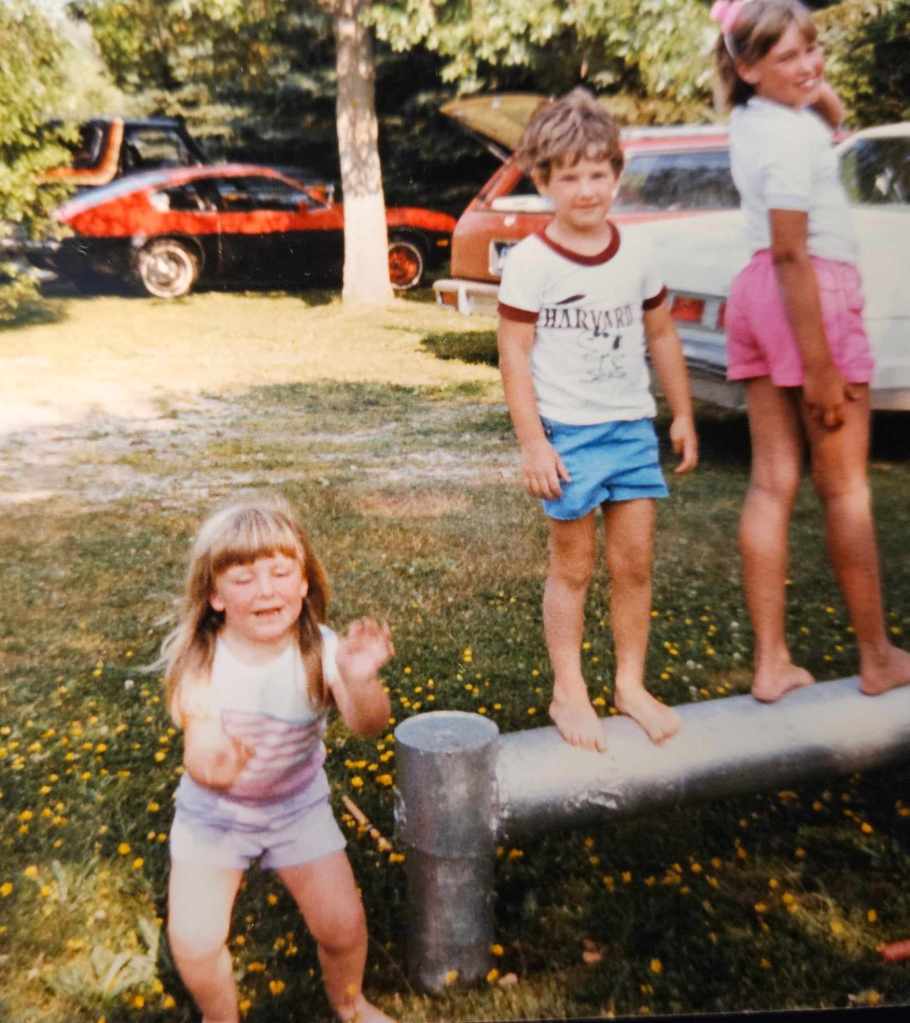
1985 – Playing @ The Cottage on Sage Lake with McTaggart and Schneider cousins.
Oddly, things improved a bit during junior high. I cared about my grades, others didn’t. Suddenly, I didn’t care so much about peer pressure. I began to see it for what it was, even though I would have given anything to be what was then considered “normal.” Keep in mind that this included the era of grunge, emo, and heroin chic. Any “normal” adolescent felt inadequate when faced with the popular culture of the time. While I finally did come into my own in high school and college, this picture makes me wonder what I missed all those years in-between. What if I hadn’t had to work so hard for self-confidence? What if I could have kept that early childhood enthusiasm and creativity? What if I hadn’t turned inward in the face of constant bullying in elementary school? What could I have accomplished? What if? That is what this picture represents: possibility. Unadultered possibility.
Ah. Camp! Such a loaded small word. First and foremost, there is camping with family and friends. Even though my parents owned and operated two campgrounds and a canoe livery, I didn’t grow up camping much in the traditional sense. Even if we didn’t camp much, the overnight canoe trips we took with Dad (Mom was one and done!) were legendary. I think about the planning that went into our trips and how we broke the “rules” and threw a tube in with our gear – Erica and I taking turns tubing for a bit; Dad pretending to leave me in the dust when it was my turn, waiting for me around the next bend. Mrs. Taylor would be waiting for us at Cedar Springs with ice cream cones.
Over the years, I attended the National Turner Syndrome Camp, memorized Bible verses at church camp, spent endless hours playing with cousins at deer camp(s) (there were deer camps on each side of my family), helped run 4-H day camps for elementary students, and ended up with my picture in the paper participating in a local Vacation Bible School day camp. I also attended Camp Oak Hills as a Brownie, my first time away from home aside from spending the night at my grandparents’ house, and the Broad Business Student Camp (BBSC) at Michigan State, which led to my decision to attend the Eli Broad College of Business (hence the name) at Michigan State University to study supply chain management. Quite simply, much of my life as a child and young adult – indeed, some of my best memories – involved camp in some way, shape, or form. I would not be the same person without it.
Each August, Grandma and Grandpa Buttrick would take us grandkids to Kenton in the Upper Peninsula (almost to Watersmeet) for a week, the site of a hunting camp passed down on Grandpa’s side for generations, the land originally homesteaded by my Forward ancestors. We spent the week visiting waterfalls, riding the hills around camp, swimming in and hiking around Tippy Lake, traveling into the tiny village of Kenton itself to visit the grocery store/library/post office, and holding target practice with Grandpa using a pellet gun. At night, there were hot games of Uno and Spoons around the living room table. As a kid, there is nothing better than sharing a bunk room with your siblings and cousins!
So many camp memories stand out. As a child attending church camp at Bayshore Camp in Michigan’s Thumb, I first experienced tipping over in a canoe. As a tween, I paired up with a boy I didn’t know well. In spite of explaining that I had years of canoeing experience as my parents’ owned a campground and canoe livery, he insisted on steering. Inevitably, we ended up in the lake, the coolness of the lake hopefully camouflaging my rising anger. I have never forgotten.
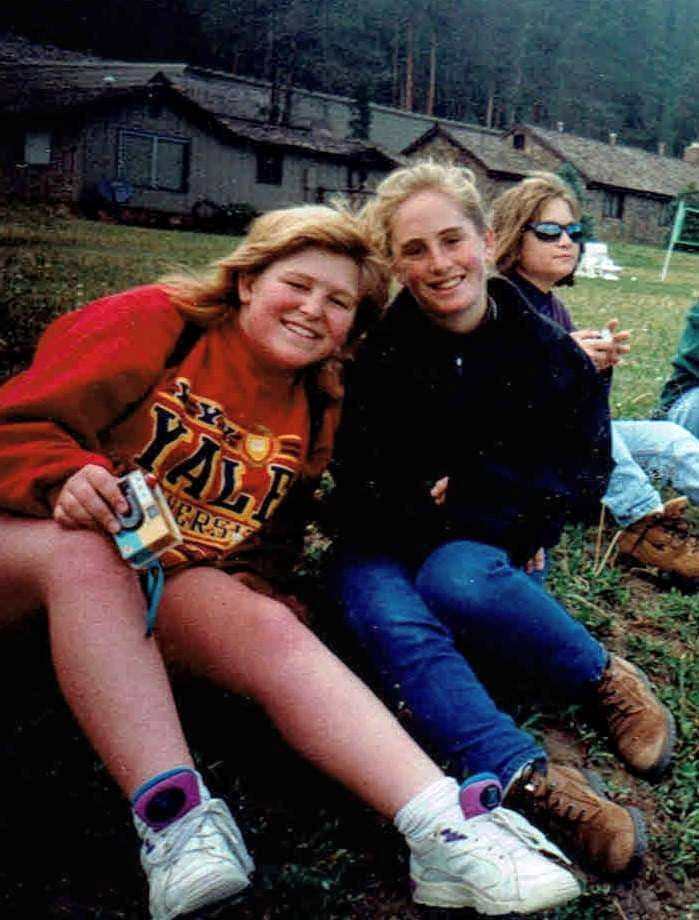
My friend Brenna and I outside of King Mountain Ranch in Estes Park, Colorado. The 2nd Annual National Turner Syndrome Camp 1996.
Years later, as a teen, I attended the National Turner Syndrome Camp at King Mountain Ranch in Estes Park, Colorado. I met other teen girls who faced the same physical, emotional, and social challenges as me for the first time. Words fail me other than to say that those experiences at King Mountain Ranch filled me with a confidence that I would not have had otherwise. One of my favorite memories is of how my friends and I scared ourselves silly watching The Shining after learning that the movie was filmed nearby. It is still my favorite horror movie and my favorite Stephen King novel. Those two years attending the National Turner Syndrome Camp still mean so much decades later. Most of all, I hope children of all ages have the opportunity to experience camp in all its forms. Those varied experiences not only added to my education in invaluable ways, but they shaped the person I am today in countless ways.














 Ramblings of a Misguided Blonde