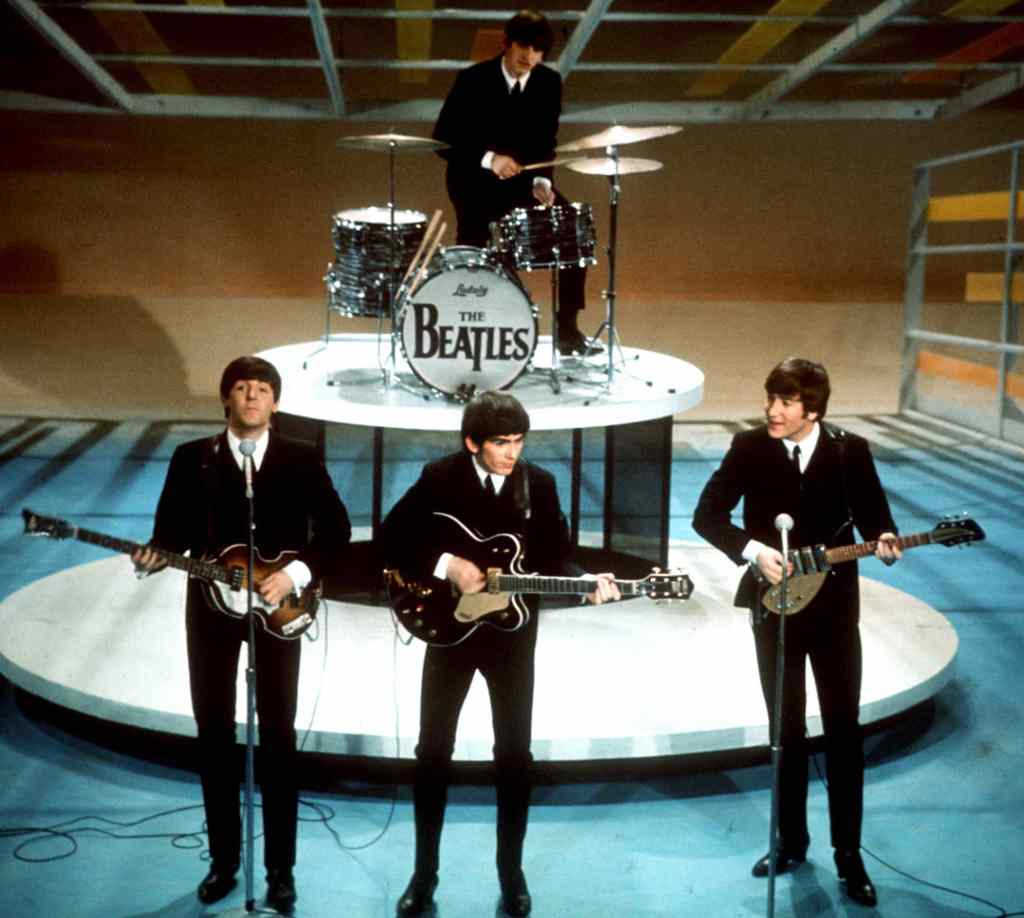
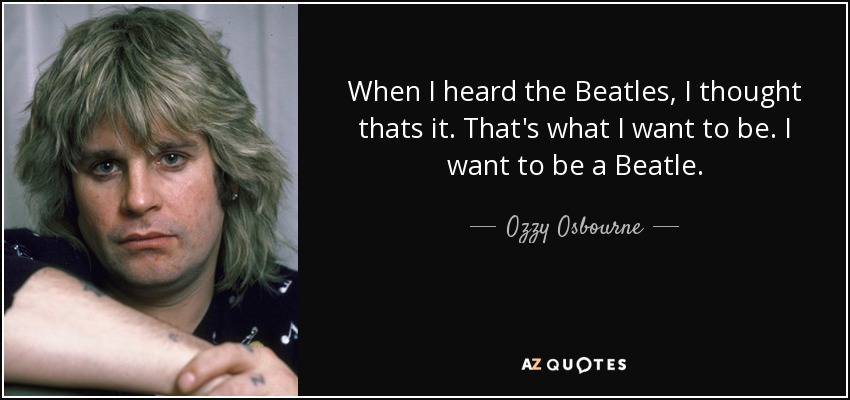
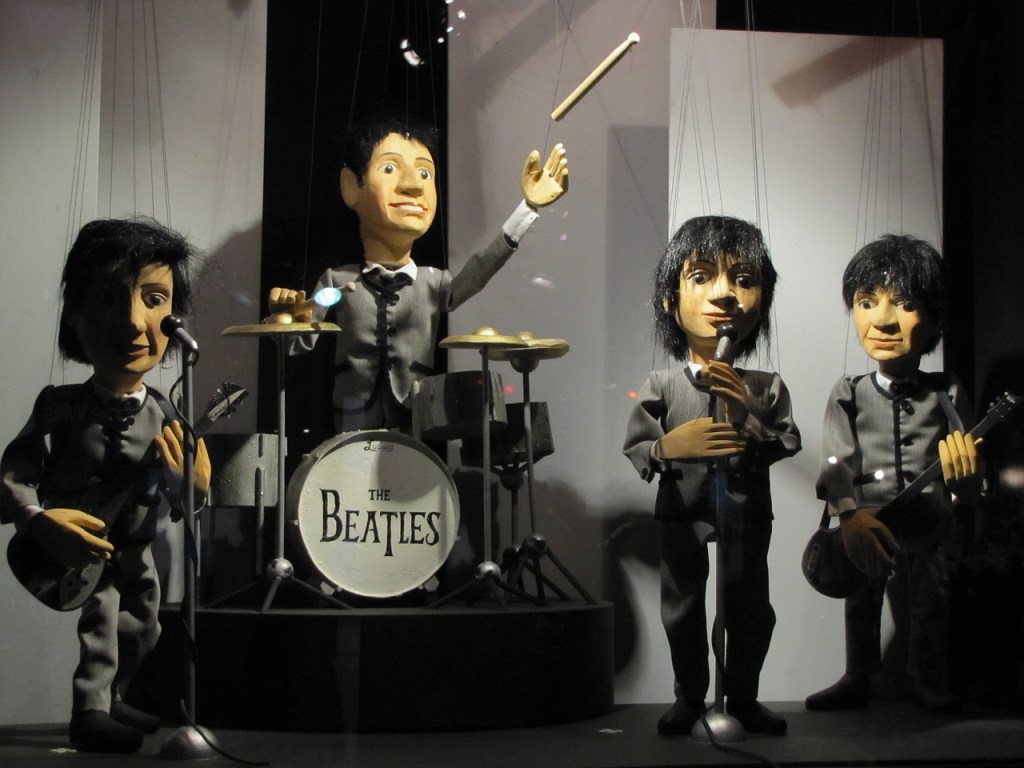
February 9th, 1964, 62 years ago today, the Beatles first appeared on “The Ed Sullivan Show” kicking off what later became known as the British invasion. Over the years, I’ve heard so many musicians state that their dream of becoming a rock star began that cold February night. Ozzy stands out. I believe it, too. I’ve heard it described as everything going from black and white to technicolor. So I thought today would be it. Today I’ll discuss my favorite Beatles song of all time.
For decades, I could not tell you which Beatles song was my favorite. There are several Beatles songs that remind me of my childhood and my mom. All of The Beatles (better known as The White Album) reminds me of my semester bumming around Spain. Then there were the Anthologies during my high school years with new music! Real Love and Free as a Bird definitely fit in the ‘90s with the likes of Oasis and Blur. In fact, I once read a comment that stated Oasis’s entire career could be summed up by Revolver. Adoring Oasis before the egos took over, I can’t unsee that comment or disagree with it. Let’s face it: Most of the music I adore would simply not exist without the Beatles’ example. This is especially true of 90’s alternative, although 90’s artists seemed to take themselves just a bit too seriously. Regardless, the Beatles will always remain a revelation and inspiration.
So why A Day in the Life? Well, first, it is the final track on my favorite Beatles album: Sgt. Pepper’s Lonely Hearts Club Band. I consider it my favorite Beatles album for one reason and one reason only: Every time I listen to it, I have to listen to every. single. track. No skipping. I know of no other album, Beatles or otherwise, that is that good beginning to end. Of course, it is considered the first concept album, too.
Also, A Day in the Life is a perfect example of why I love the Beatles music so much. First, it tells a story. One can get lost in the lyrics and the story. Second, it is pure Lennon/McCartney magic. Not too hard, not too sweet – just right! It is really two songs in one with a memorable bridge in between. There are plenty of examples of Beatles songs structured like this, but it is the Wings songs that come to mind. Some of my favorites, Band on the Run, Live and Let Die, and Uncle Albert/Admiral Halsey, just to name a few. What’s not to love? So, let’s take a minute today to appreciate all the amazing music we’ve enjoyed over the last several decades.
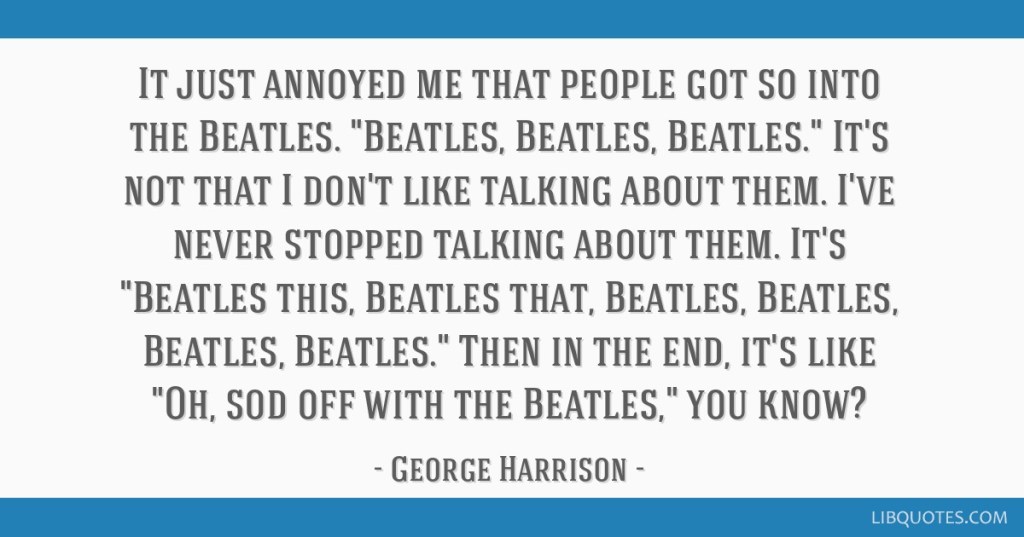
Ladies and gentleman, quite possibly the best Beatles quote by a Beatle.
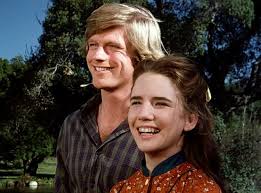
Dean Butler as Almanzo Wilder in Little House on the Priarie
This year, the TV show Little House on the Prairie celebrates 50 years since its television debut. Oh, and does that show still have a following. To celebrate, several events were held at various locations throughout the country, including most of the homesites of the Ingalls and Wilder families. They even recreated several of the sets at Big Sky Movie Ranch in Simi Valley, California, where most of the series was filmed. Infamously, the last installment of the series saw the original set of the town literally destroyed as part of the plot. Under the terms of filming, the producers of Little House on the Prairie contractually had to return the land to its original condition.
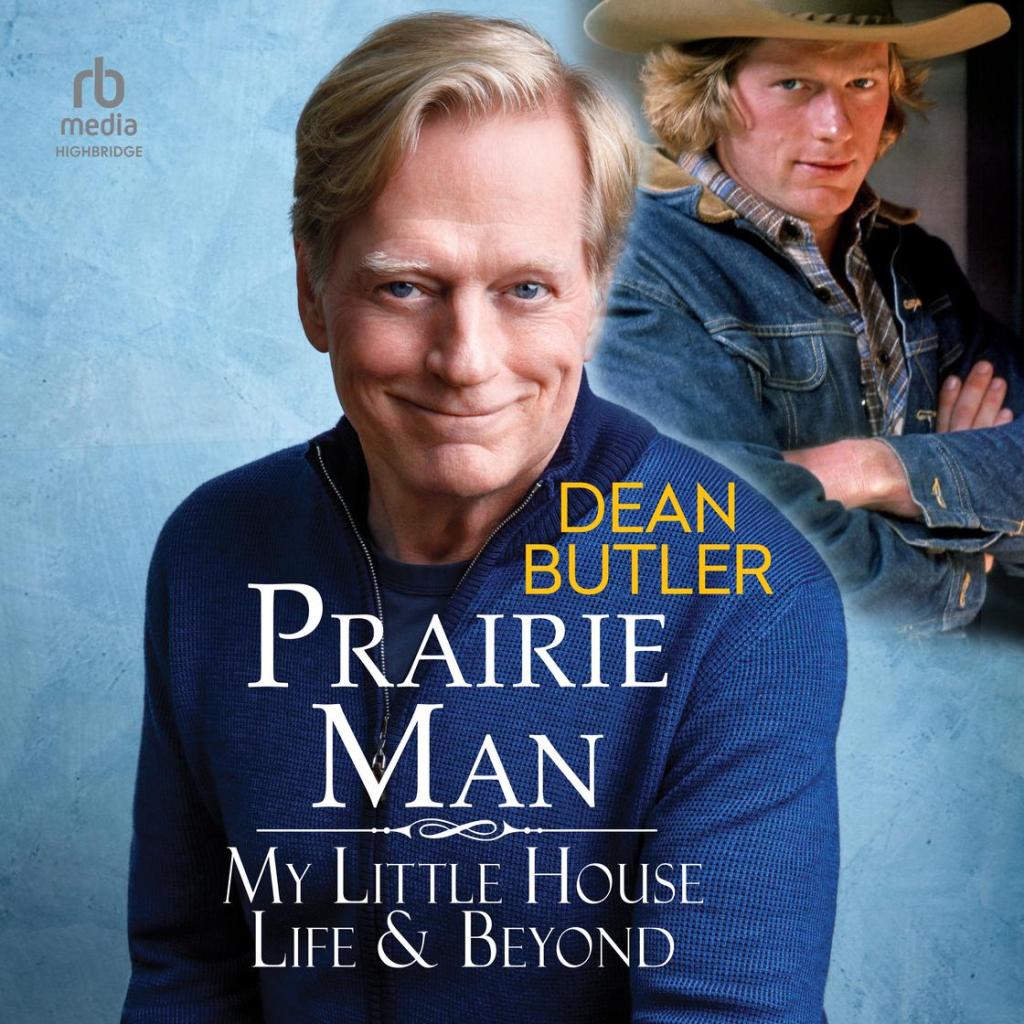
So, where does Prairie Man by Dean Butler come in? First, the book debuted this summer in the midst of all of the events. Second, and most importantly, Dean Butler, who played Almanzo Wilder in the last years of the series, and Alison Arngrim, the one and only Nellie Oleson, who famously penned Confessions of a Prairie B*tch, have worked tirelessly to keep the legacy of the TV show alive. In fact, this entire year, they decided to host a podcast dedicated to all things relating to the 50th anniversary of the Little House on the Prairie TV show.
Prairie Man stands out for a couple of reasons. First, I may not be technically correct on this, but I believe that Dean Butler is the oldest surviving male cast member. Several actors that played young boys on the series survive, but the grown men, including Michael Landon, Victor French, Richard Bull, and Dabs Greer, just to name a few, are long gone. While there are several memoirs written by female cast members, including two alone written by Melissa Gilbert, Prairie Man is the only one written by a man.
While I’ve only read Confessions of a Prairie B*tch by Alison Arngrim (you can read my review here) and Prairie Man by Dean Butler, they could not be more different. I loved both, but I enjoyed Butler’s sense of history, not to mention his diplomatic handling of tensions between fans of the books and fans of the TV show. He addressed all of the controversies surrounding both series well.
I learned a lot. While I knew that Rose Wilder Lane’s “adopted” grandson, Roger Lea McBride, ended up with the television rights to the novels, I did not know the full story. The real story is included in Prairie Man. In the early 70s, Ed Friendly purchased the rights from McBride due to his wife’s and daughter’s love of the books. Only when Michael Landon became involved as executive producer, taking the TV show further and further from the original books, did trouble occur. According to Butler, Roger Lea McBride became horrified when realized what he had done. Like Friendly, he envisioned a TV series much more faithful to the books.
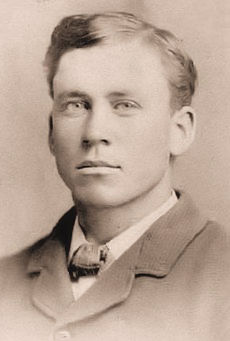
The real Almanzo Wilder, subject of Farmer Boy by Laura Ingalls Wilder
Eventually, all of this grew tension between Landon and Friendly. Landon’s vision, of course, ultimately prevailed. It may have been for the best. Ask yourself, how many children and adults were introduced to the books via the TV show? Alison Arngrim even admitted that she didn’t read the books until after being cast as quite possibly the best child villain ever portrayed on television, Nellie Oleson. Michael Landon may have taken extreme creative license, but love it or hate it, Little House on the Prairie, the television show, is still shown all over the world in syndication 50 years later. It will not die.
The funny thing is that I used to blame Roger Lea McBride for selling the rights to the television series and Michael Landon for what it became. I used to view the Little House series of books as a cautionary tale as to what can happen if an author’s legacy isn’t well-guarded or just ends up in the hands of attorneys. For those who don’t know, Rose Wilder Lane never had children (she never formally adopted Lea), and thus, with her death in 1968, Laura Ingalls Wilder and Almanzo Wilder no longer had any direct descendents. I see it differently today. I suppose I now subscribe to the old saying “any publicity is good publicity.”
While I probably would have discovered all of the books on my own, especially after my 2nd grade teacher, Mrs. Butz, read Little House in the Big Woods to our class, I doubt any of it would have left such a lasting impression without the TV show. Early elementary school would not have been the same without it. I distinctly remember jumping off the bus after school, pigtails flying behind me, eager to catch the 4 PM reruns. Funny note: Due to the fact that I grew up on the reruns, I thought Dean Butler was significantly younger, by at least a decade, than he actually is. His book, of course, made this clear.
Today, I am not necessarily a fan of the TV show, although I do greatly admire what Dean Butler and Alison Arngrim have done for all Little House on the Prairie fans. I suppose I am not a typical fan. Normally, most people are devoted fans of the books or the TV show, not necessarily both. More than anything, I am a huge fan of the real person, the writer herself, the real Laura. Her true story is far more fascinating than just the books. She lived an incredibly full additional 70 years after the life she described in all of her books. When you add in all of the drama surrounding her only daughter, Rose Wilder Lane, it justifies all of the relatively new scholarly work surrounding the Ingalls and Wilder families. There are still so many questions left to answer.
If you are interested in the Little House series at all, whether book or TV show, Prairie Man is well worth reading. Butler makes the case that he feels he was born to play Almanzo. Growing up on a ranch in California, he describes in detail how his entire career has been shaped by that one role. As he grew older, he decided to lean into it and run with it, much as Alison Arngrim has over the last few decades. Fortunately for Little House fans, its incredible legacy is in good hands for the time being.
You can also check my review of Prairie Fires by Caroline Fraser here.
Over the last few weeks, I’ve watched as my students in my creative writing club have bonded over pop culture – every form of storytelling one can imagine. They bonded over books, movies, video games, and above all, music. Several left ecstatic having met other students who share similar tastes in TV, movies, music, and more. What is it about pop culture that binds us together?
I just finished The Women by Kristin Hannah, which dives deep into the experiences of field nurses in Vietnam. Throughout the book, particularly in chapters set in Vietnam, certain songs by a myriad of artists set the scenes without mentioning one lyric. The names of the songs and artists was enough. Then there were the clothes. Set roughly from 1967 to 1982, author Kristin Hannah used descriptions of hair and clothing to add realism and depth to her setting and characters. As one of the finest pieces of historical fiction I’ve ever read, I will be reviewing the book at a later date. It is that good.
Up until fairly recently, I would have told you that we used to bond more closely over pop culture in the past. Growing up in the 80s and 90s, we only had three TV channels for a large chunk of my childhood. Most hit TV shows were shown on either NBC, ABC, or CBS. That’s only changed over the past two or three decades. Shows such as M*A*S*H set ratings records that will probably stand the test of time. Today, with dozens of streaming services and an endless variety of cable channels, TV viewers have more choices than ever.
Music changed, too. As a child, I watched MTV and VH1 come into their own. With shows like Unplugged, Behind the Music, and Pop Up Video shown among a solid stream of increasingly intricate music videos, they were all about the music. In fact, I recently came across a conversation in which my contemporaries argued that it can be difficult for people of our generation to separate certain songs from their music videos.
Indeed. I have a difficult time imagining TLC’s Waterfalls, Michael Jackson’s Thriller, or Jamiroquai’s Virtual Insanity without their iconic videos. I could name a dozen others. Today, we have it all at our fingertips. We can pre-order albums in our medium of choice or subscribe to an all-inclusive music service for a fraction of the price of one traditional CD. That simple fact made my Xennial heart incredibly happy and angry at the same time.
Personally, when it comes to music, I am glad that I had the opportunity to experience the transition from vinyl to tapes to CDs to MP3s to streaming services … and all the way back to vinyl for collectors. I watched as a wide-eyed little girl as Madonna and Michael Jackson exploded onto the scene, respectively becoming the Queen and King of Pop, ushering in a new era of great music. Thanks to my Gen X elders, I developed a deeper appreciation for 80s music, expanding beyond pop rock.
Today, there are infinitely more choices out there. Yet, it is easier than ever to connect to other fans of your favorite TV shows, movies, music, books, and so much more. No more annoying dial up, parents or siblings waiting not so patiently to use the phone. Things might be a bit fragmented, but when you find your tribe, there is no doubt.
At times, the ending of a TV series works, and at others, it doesn’t (I’m looking at you Seinfeld!). When Cheers aired its final episode in May 1993, I watched. I remember Shelley Long (Diane) returning and the cast partying as it aired (infamously so), but I do not remember it being so poignant. The final scenes with Sam and Norm, and later, Sam alone in the bar, are now among my favorite TV series endings of all time.
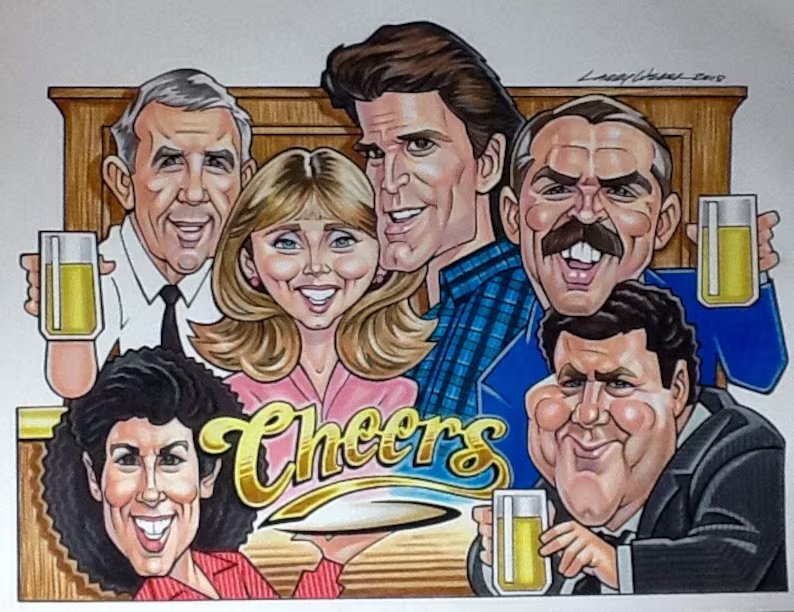
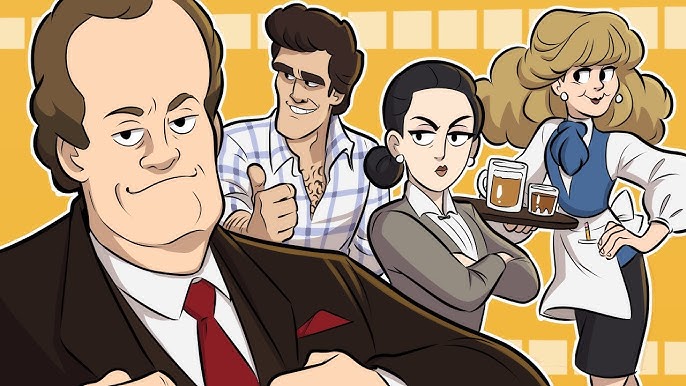
Growing up, I adored Cheers. I watched it with my parents every week. As an adult, I rewatched the series. The characters still hold up. It wasn’t just the main characters – Sam, Diane, Coach, Carla, Woody, and Rebecca – that drew us back every week, but an entire complimentary cast of characters capable of anything – Norm and Cliff, not to mention Frasier and Lillith. The episode in which we met Lillith remains one of the funniest. Throughout the rest of the series, Dr. Lilith Sternin-Crane developed into one of the funniest and quirkiest female characters on TV. She is still one of my favorite TV characters after all these decades.
Who can forget Lilith? Enough said.
Aside from all of the laughs and hijinks throughout the series, the humanity of all of the characters (every last one deeply flawed) shined through. Yet, the last scenes of the final episode hit me right in the gut. It isn’t every day that a TV show can make you deeply and profoundly appreciate what you have.
It starts innocently enough. Norm stays after everyone else heads out after welcoming Sam back to the bar after escaping marriage to Daine yet again. He didn’t want anyone else to hear what he has to say, and he’s up for one last beer, of course. He tells Sam that love is the true meaning of life. He continues to state that people are always faithful to their one true love, that he’d be unable to be unfaithful to her. When Sam asks whom that would be, Norm simply states “Think about it, Sam,” smiles, and leaves, setting up the final shots of Sam in the bar alone.
Alone in his bar, Sam slowly realizes that it is his bar that is the love of his life. He recognizes just how much it, and all those in it, mean to him. He even straightens Coach’s framed portrait of Geronimo before closing up. In a clever twist, the final shot of Sam closing up and heading towards the back entrance of the bar mirrors the opening of the series in which Sam makes his way to the front of the bar as he is opening up for the day.
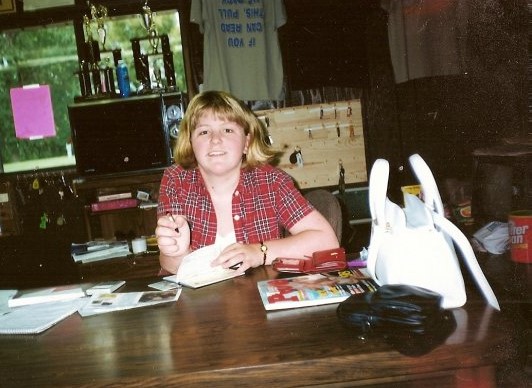
Nearly 30 years ago … Working with Grandma Reid at the canoe livery.
All I can say is this: As someone who has spent her entire life watching her parents and grandparents build a family business – and as someone who will one day fully take over said business with her brother – I get it. Boy, do I ever get it. I can’t imagine my life without the canoe livery. I hope that I never have to do so. It is the people – employees (current and former) and customers – that make the business, along with the river and the land itself. I’m lucky, indeed.
I say it often, but we have the best customers. I estimate that 99% of our customers are great. The remaining 1% make for great stories. We are currently winding down for the year, but when spring comes once again, I will be ready to start it all over again.
Dr. Fraiser Crane in one of the longest-running TV characters in history. The reboot of Fraiser will soon start its second season.
Orginally posted on an earlier version of my blog, the post below still holds true.
Where do I even start? I don’t think another TV show ever meant as much to me as The Wonder Years. As I grew up watching the show as a child, I wanted to be Winnie Cooper. I loved her look. I wanted to have the same long brown hair and dark brown eyes. She even looked great when she pouted, which occurred just about any time she talked to Kevin. Something intangible about the show, and Winnie Cooper, stuck with me through the years.
That isn’t even to mention the star of the show, Kevin Arnold. How could any girl resist all of the attention and love he gave Winnie? I don’t think any adolescent girl has ever been as greatly admired and loved as Winnie Cooper. None of it seemed to matter to her. Of course, that is exactly what frustrated me with the show; it is also what made the show great. The audience never knew week to week whether or not Kevin and Winnie would be together. In the end, it wasn’t to be. Winnie went off to study art history in Paris and Kevin went on to start a family of his own, without her. Here is a link to a wonderful Top 10 of Winnie and Kevin together.
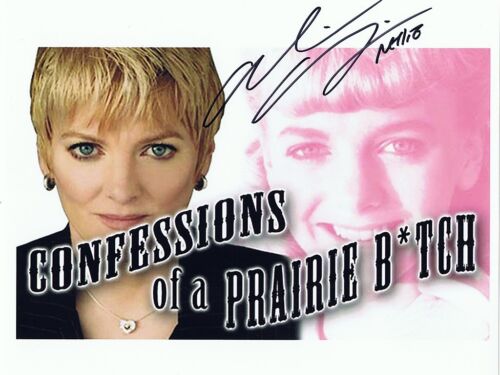
Where do I begin? First, if you are or were a fan of The Little House on the Prairie TV show in the 70s and 80s, I can’t recommend this book enough. Be aware: This isn’t saccharine. Far from it. If you are easily offended, this probably isn’t for you. However, if you loved to hate Nellie as a little girl and wished each week for Laura to give Nellie exactly what she deserved – in spades – this book is for you. If you ever thought that playing the most outrageous villain possible on TV would be fun, once again, this book is for you. Last but not least, if you count Nellie Oleson and her overbearing mother Harriet among the favorite TV characters from your childhood, you need to read this book.
Frankly, both The Little House on the Prairie TV show and the children’s book series were a huge part of my childhood. I can’t imagine growing up without either. I do know that by 2nd grade, I was hooked. Mrs. Butz reading Little House in the Big Woods to our 2nd grade class saw to that. In early elementary school, I would fly off the bus to make sure I didn’t miss the start of Little House on the Prairie at 4 PM, in much the same way I made sure I was home at 4 PM during my high school years to watch Oprah. It was simply what I did, and I loved every minute of it.
I know that there are still a lot of adult fans of the show out there – millions of them, in fact – but I’m not really one of them. As an adult, I couldn’t get over the increasingly bizarre storylines that strayed further and further from the books – Albert’s opium addiction, anyone? Then there was the issue of no mountains in Minnesota, where the show was supposedly set, and the fact that the Ingalls family spent a big part of Laura’s childhood in DeSmet, South Dakota. In reality, the Ingalls family didn’t live in Walnut Grove for long. Still, there was something special about the show. It might be a little too sweet for my taste now, but back then, it was the best.
Nellie and Harriet made the show, of course. The Ingalls were so wholesome and down to earth that they needed Nellie and Harriet as foils. Personally, I think the show would not have worked without their over-the-top antics. They had to be just that outrageous. In the book, Alison talks lovingly about her TV parents. Supposedly, in real life, they were similar to their TV characters, although Katherine MacGregor (Harriet) was much nicer, even if just as bold. Alison’s descriptions of Katherine alone make the book worthwhile. As fun as Harriet was to watch, the best scenes were the ones in which Nellie and Laura actually fight.
About Laura and Nellie … in real life, Alison Arngrim (Nellie) and Melissa Gilbert (Laura) were best friends. They spent a lot of time together on and off set and at each other’s homes. One of their favorite pastimes happened to be simply appearing in public together. People freaked out. I can only imagine how much fun they had playing up their “rivalry.”
Alison’s antics with Melissa Gilbert are a great part of the book, but there is so much to unpack here. First, there is that voice. I chose to listen to the audiobook version as soon as I learned that she read her own book. As soon as I started listening, I knew I had made the right choice. Regardless, the book would have hit me with a huge wave of nostalgia, but Alison reading her book in a voice that I have always associated with childhood evil personified: priceless.
In all fairness to Alison, she comes across as extremely down to earth in her book to the point that I’d actually love to meet her. She spends quite some time discussing the perils and perks of playing one of TV’s greatest child villains. Can you imagine growing up playing a character people loved to hate? Once, during a publicity event at a private school, an event that she attended with Katherine MacGregor (Harriet Oleson), both in full costume, some of the students shoved her so hard that she laid face down on the pavement for a while until her father realized what had happened to her. He ended up taking her home immediately. It was the last time she attended a publicity event in costume. How do you deal with that all before adolescence?
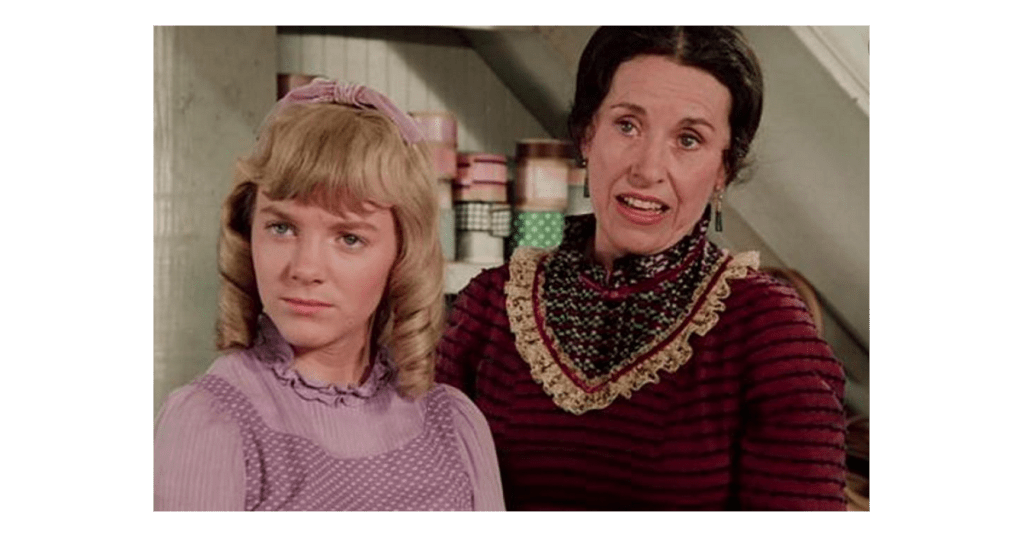
Alison Arngrim as Nellie Oleson with her TV mother, Katherine MacGregor as Harriet Oleson.
In the book, Alison uses the trauma she experienced as a child as a way to frame her memoir. No, her trauma isn’t exactly what comes to mind with young stars and Hollywood, but sadly, it seems all the more common – and of course, very real. I’m not going to discuss it here for many reasons; the main one being that, in a way, it is the point of her memoir. I don’t want to spoil it for those who haven’t read it. She has used that trauma to try and help prevent others from experiencing the same thing. In essence, she uses her “inner b*tch” to create real legislative change in an effort to protect kids – all kids.
One of the more interesting tidbits I learned in the book is the history behind why the TV show deviated so much from the books. Michael Landon supposedly exclaimed at one time: “My God! Have you actually read the books? There are descriptions of churning butter!” In other words, they had to up the action. I get it, I do. What makes a great book doesn’t necessarily make great television.
I suppose that’s what has always bothered me about the TV show. As an aspiring writer, it sickened me to think what happened to Laura Ingalls Wilder’s original work. Now, older and wiser, I can see the value of the TV show too. I am sure it inspired millions of kids to pick up the original books. All publicity is good publicity, right? For people who grew up with the TV show, I can’t recommend Confessions of a Prairie B*tch enough. There are so many great aspects to Alison Arngrim’s memoir. It is a wonderful combination of nostalgia, good story, and humor. By the way, Alison’s voice impression of Melissa Gilbert is hilarious. Several other memoirs have been written by the child stars of Little House on the Prairie. In fact, I plan on reading both of Melissa Gilbert’s books. I will be surprised if Confessions of a Prairie B*tch doesn’t remain my favorite.
Good ol’ Night Court. I have to admit: I’ve been a fan as long as I can remember. Growing up in the ‘80s rocked and that included TV. My favorites were The Cosby Show, The Wonder Years, Cheers, and of course, Night Court. Something essentially slapstick quirky just resonated with kids. I largely tuned in for all the zany characters and the craziness that befell the cast. Keep in mind I was all of 11 when it went off the air.
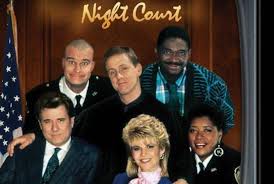
My mom remembers that my favorite character was Dan, which rightfully left her a little concerned. That is not how I remember it at all. Yes, I loved to laugh when Dan quite rightfully got himself into trouble every episode, but my favorite characters were Christine and Harry. Just like everyone else, I wanted them to end up together. The bailiffs – and I mean all of them going back to Selma – were great too. I suppose that is what bothers me most: Night Court never seemed to get the proper sendoff or recognition it rightfully deserved. What endears me most about Night Court is the fact that it never tried to be something it was not. We just loved it for the campy, quirky, crazy show that it was. Anything could, and often did, happen.
This is precisely what gives me hope for the reboot. Going by what I saw in the first two episodes, Night Court isn’t trying too hard. Is it perfect? No. I want to know what happened to Christine, Max, Roz, and Bull. Christine especially deserves a mention considering the “ending” of the original series included both Harry and Dan professing their love for her. While Harry decided to remain a judge and turndown several incredible job offers, he and Christine acknowledged their feelings for one another. At the end of what should have been the last episode (altogether another story that only highlights issues with the ending), Dan decides to resign as assistant DA and follow Christine to Washington, DC. Harry is told this, and immediately exclaims “My Christine!”
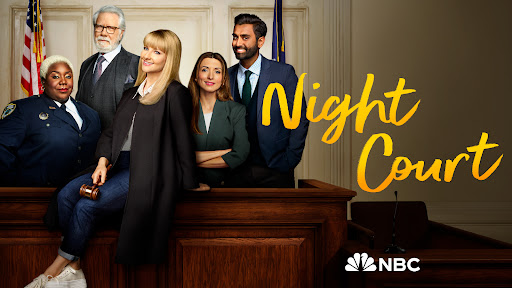
In the first episode of the reboot, Harry’s daughter Abby moves to New York to become the new night court judge, taking over a position her father held 30 years ago. She is just as idealistic as her father. She also happens to look as though she could be Harry and Christine’s daughter. Almost immediately, the public defender in her court quits and she looks up Dan. Given the “ending” to the original series, Dan most assuredly would have asked after her mother if indeed Christine was her mom. We only know that Harry is her dad. Sadly, much of the original cast has since passed on, including Harry Anderson (Harry Stone), Markie Post (Christine Sullivan), and Charles Robinson (Mac Robinson). If I have one hope for the new reboot, it is that they find subtle ways to allude to the earlier show/cast. They do a wonderful job of doing so in the case of Harry and Dan. As of yet, no one else is mentioned.
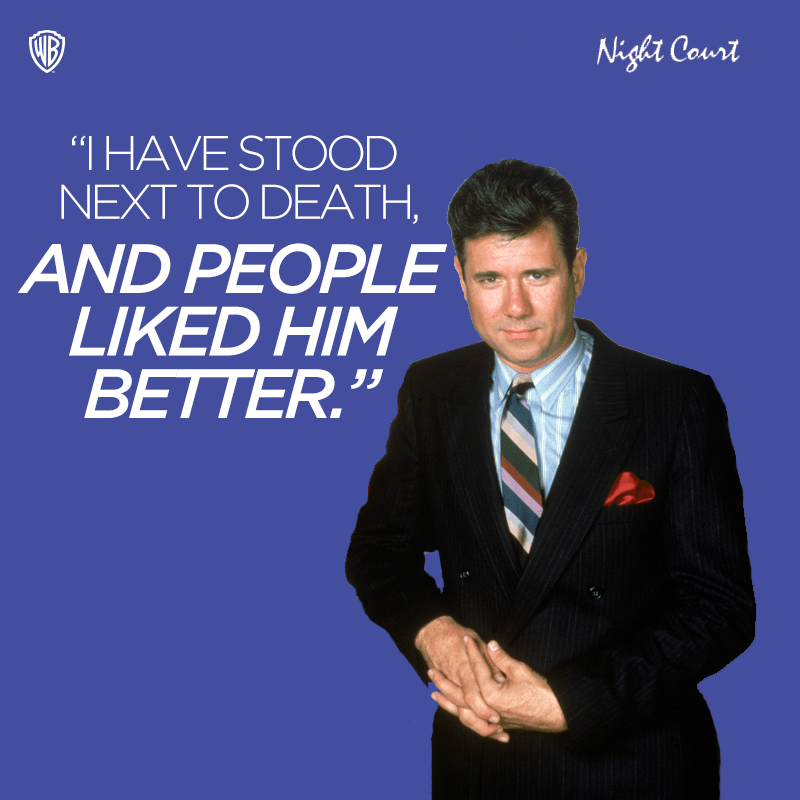
I admit, I wavered as to whether or not I was even going to watch. Then I learned that John Larroquette (Dan Fielding) was instrumental in getting it made, and the new cast consists of fans who grew up with the show much as I had. The first two episodes are off to a solid start. We will see if it will find its own niche. I will say that the creators of the reboot did an incredible job of keeping the vibe of the old show (the dingy old courthouse in particular) while “updating” things a bit. The new bailiff, Donna Gurgs, somehow channels both Roz and Bull at different times throughout the show. There are tons of nods to the ‘80s in new show, my favorite being the mural of the Golden Girls – a stupid silly plot point that could only take place in Night Court.
I recently watched some of the earliest episodes of the original Night Court from season 1. It is clear that it took a while for the show to hit its stride – a few years, in fact. The reboot definitely has potential, and I am reassured that it is in the hands of fans of the original. Do not be afraid to check it out. It is currently streaming on Peacock.






 Ramblings of a Misguided Blonde