July 1984 – Tawas, Michigan – Hamming it up with my Schneider and McTaggart cousins at Aunt Tara and Uncle Bill’s wedding. Thank you Aunt Amy for helping me locate this picture!
Sometimes, a picture can bring up a wide-range of emotions: joy, sadness, nostalgia, and everything else. Earlier this summer, I sent my aunts on a search for the picture above. It had been on my mind for some time. I consider it one of the definitive photos of my childhood; one that has always stood out. First, Grandma Buttrick had it framed in one of the back bedrooms of her house for many years. I always enjoyed coming across it during visits. For that reason alone, the picture remains a favorite.
While I was too young to remember having the picture taken at my Aunt Tara’s wedding to Uncle Bill in July of 1984, I grew up hearing all about it. I can’t tell you how many times I heard the story of how I, at three years old, took the instruction to smile at everyone as a flower girl walking down the aisle much too literally. I stopped at every pew. At the end of the ceremony, I cried and ran after my mom as she left the church in the processional as a bridesmaid. I didn’t understand that I just needed to follow my older cousins. My only memory from that day is a hazy notion of playing at the beach on the animal-shaped play equipment at the Tawas City park during the reception.
July 1984 – Smiling for the camera right after the ceremony … Thank you to Aunt Tara for locating this gem.
In the picture, I see myself as a little girl full of personality and character. There is no doubt that I was a ham like my mom, an extrovert. When I look at this picture, I see “before.” Before self-doubt, before losing self-confidence, before I realized that my body is, and always has been, all wrong; in other words, before kindergarten. Prior to kindergarten, no one – not my parents, grandparents, cousins, other adults, other children, or preschool classmates – made me feel inferior in any way. No one asked me to be something that I wasn’t, no one called me fat or ugly. I could be myself.
Don’t get me wrong, I loved school. I would not be a teacher today if that wasn’t the case. I loved learning, I had some great teachers, and most of my classmates were great. Yet, I dreaded gym and recess all throughout elementary school. In gym, always picked last for any game, I just wanted to be good enough. During recess, other students started picking up on just how different my body is and was. When you hear that you are fat and ugly on a daily basis at that young of age, you start to believe it. It becomes a part of you.
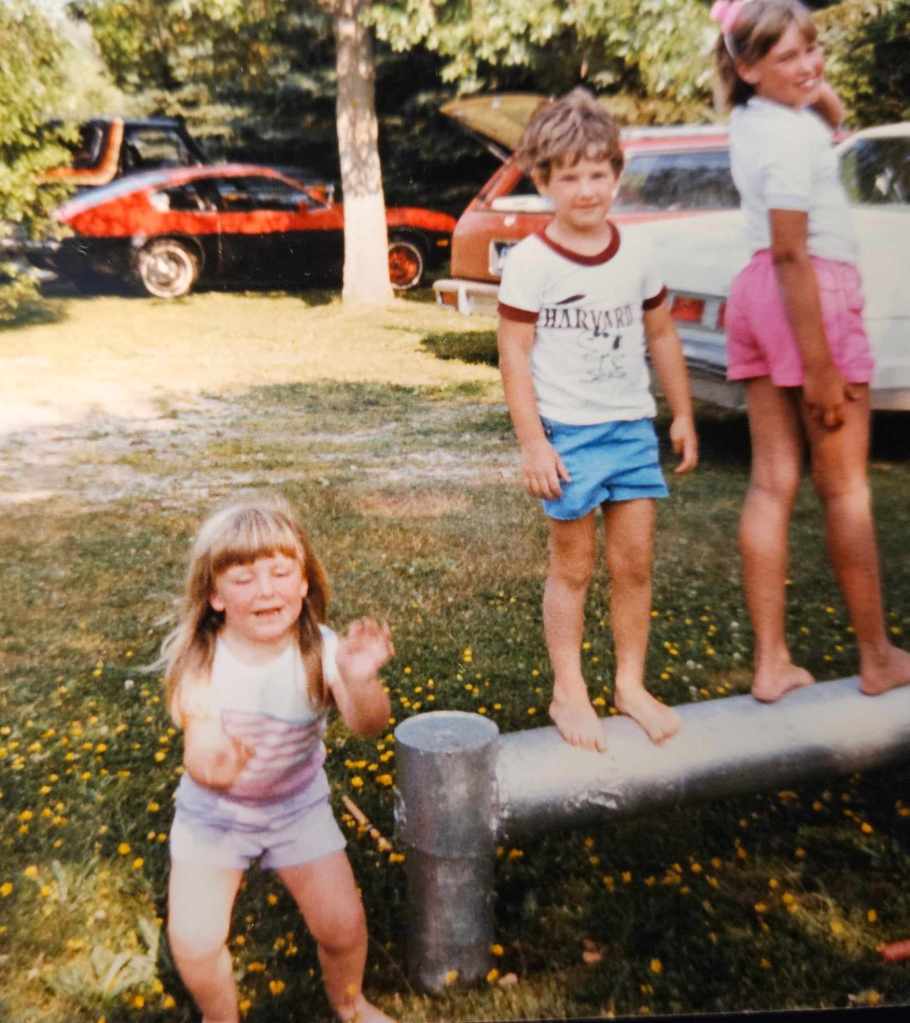
1985 – Playing @ The Cottage on Sage Lake with McTaggart and Schneider cousins.
Oddly, things improved a bit during junior high. I cared about my grades, others didn’t. Suddenly, I didn’t care so much about peer pressure. I began to see it for what it was, even though I would have given anything to be what was then considered “normal.” Keep in mind that this included the era of grunge, emo, and heroin chic. Any “normal” adolescent felt inadequate when faced with the popular culture of the time. While I finally did come into my own in high school and college, this picture makes me wonder what I missed all those years in-between. What if I hadn’t had to work so hard for self-confidence? What if I could have kept that early childhood enthusiasm and creativity? What if I hadn’t turned inward in the face of constant bullying in elementary school? What could I have accomplished? What if? That is what this picture represents: possibility. Unadultered possibility.
Orginally posted on an earlier version of my blog, the post below still holds true.
Where do I even start? I don’t think another TV show ever meant as much to me as The Wonder Years. As I grew up watching the show as a child, I wanted to be Winnie Cooper. I loved her look. I wanted to have the same long brown hair and dark brown eyes. She even looked great when she pouted, which occurred just about any time she talked to Kevin. Something intangible about the show, and Winnie Cooper, stuck with me through the years.
That isn’t even to mention the star of the show, Kevin Arnold. How could any girl resist all of the attention and love he gave Winnie? I don’t think any adolescent girl has ever been as greatly admired and loved as Winnie Cooper. None of it seemed to matter to her. Of course, that is exactly what frustrated me with the show; it is also what made the show great. The audience never knew week to week whether or not Kevin and Winnie would be together. In the end, it wasn’t to be. Winnie went off to study art history in Paris and Kevin went on to start a family of his own, without her. Here is a link to a wonderful Top 10 of Winnie and Kevin together.
The post was originally published on an earlier version of my blog. I’ve slightly updated and modified the post. Anything in bold I added to the original post. Tigers’ opening day is April 5th at Comerica Park! GO Tigers!
I’ve tried writing this post several times over the last several years. Sometimes there is so much to say, no mere words can do the subject justice. Somewhere along the line, somewhere between childhood and adulthood, I forgot what baseball once meant to me. I also forgot just how intertwined baseball is with some of my favorite childhood memories.
Back in 2012, it all started with me getting the crazy idea that my baseball obsessed ex-boyfriend Brian and I should watch the Ken Burns’ documentary Baseball – all almost 20 hours of it. I checked it out from the library sometime early in September 2012. Brian and I then spent the next couple of weeks watching the entire documentary, including great interviews with Bob Costas, Yogi Berra, and Rachel Robinson, the widow of Jackie Robinson, among others.
For me, the most memorable part of the series had to be the clip of Bob Costas discussing his first experience at Yankee Stadium with his father. As a young child, he was awed by the sheer size of the stadium and the size of the pitching mound. After the game, fans back then could cross the field to a second exit. As Bob Costas and his father crossed the field, he became very upset. He loved baseball so much that somewhere during his childhood, he got the idea that Yankee greats such as Babe Ruth and Lou Gehrig were buried on the field. He didn’t want to disturb what he believed to be their graves. The stories of baseball memories bringing together fathers and sons, as well as fathers and daughters, stayed with me.
Mom, Dad, and I ~ 1983
Dad sporting his lucky #3 hat. Some of my earliest memories are of watching the Detroit Tigers on TV with my dad.
I found myself asking why baseball is so different from football, hockey, or basketball. I’m not sure, but I do know this: there is something about baseball that transcends time. I have memories of watching the Red Wings win the Stanley Cup in 1996 and 1997 with Dad, as well as countless other games, but my most powerful memories all relate to baseball.
Many of my earliest memories of Dad involve baseball. As a very young child, I remember watching the Detroit Tigers with Dad and eating Schwann’s black cherry ice cream. Somehow, Dad ended up attending one of the 1984 World Series games at Tiger Stadium. At that game, he bought a signed baseball that sat on the roll-top desk in his office for years. In fact, it might still be there. I loved that baseball and thought that it was amazing that Dad attended one of the World Series games. I also remember rummaging through the top drawer of Dad’s desk and coming across his father’s Masonic ring. In the eyes of a young girl, the Masonic symbol was a baseball diamond. Above all, there were the games.
My youngest nephew, Owen, sporting lucky #3 and keeping the tradition alive, even if it is his basketball jersey. Dad always seemed to end up as #3.
Throughout my early childhood, Dad, a former high school athlete who played football, basketball, and baseball, played on a men’s softball team. As a preschooler, I loved watching Dad play ball. I liked the entire experience. I was so proud to have Dad out there in his lucky #3 baseball hat with his well-worn glove. I loved watching him bat.
Of course, it wasn’t just about baseball. I also loved playing in the dirt next to the dugout, running around the poker straight pine trees behind the dugout, and playing with the old-fashioned water pump between the dugout and the pines. More than anything, I loved going to the bar with everyone after the games. As Dad and his friends, along with their wives and girlfriends, drank pitchers of beer and talked, I played pinball, foosball, Pac Man, and enjoyed pop and chips. It is no wonder I could relate to adults well as a child. I spent a lot of time around adults and enjoyed every minute of it.
I also loved spending time at my grandparents’ house. A trip to my dad’s parents’ home wouldn’t be complete without spending time with their neighbor’s son, Brian K. We were the same age, and he happened to have something I wanted desperately as a child, a tree house! I vividly remember one afternoon spent playing in his tree house. His dog somehow came off his lead, and I became scared as I really didn’t know his dog. Brian K. told me to hang out in the tree house until he chained up the dog.
That day, his mom invited me to attend one of Brian K.’s Little League game with his family – a big deal in the eyes of a six year-old! I felt honored to be sitting on the sidelines cheering on Brian K. along with his parents. At the time, of course, I wanted to be out there on the field too. While I did play softball for one season at age 11, I am no athlete. Grandpa Reid, who loved to watch me play, insisted he never saw anyone walk more than I did. As I’ve always been exceedingly short, no one ever learned how to pitch to me. Instead, I collected baseball cards.
I’m not exactly sure when and why I started collecting baseball cards, but my favorite will always be the Topps 1987 wood grain cards. They remind me of Grandpa B. My maternal great-grandparents owned a cottage on Sage Lake in northern Michigan. I spent many summer weekends there with my parents, my siblings, my grandparents, and much of my extended family. At the cottage, Grandpa loved to get all of us grandkids, all girls at the time, in his station wagon to take us to the pop shop. He let us pick out whatever we wanted. I picked out baseball cards to add to my collection, mainly ’87 Topps. I still have my baseball card collection and fond memories of Grandpa asking me if I was sure that is what I wanted.
I loved everything about collecting baseball cards: organizing them by team, deciding which packs of cards to purchase, and looking up prices. All fun! It is fitting that I lost interest in collecting cards as I became a teenager. My last full set dates to the strike-shortened 1994 season. Around that time, I lost interest in baseball. Coincidentally, it is also the same year the local IGA, my favorite place to purchase cards, closed.
That same year, Dad took Erica, Garrett, and me to a Tigers game at Tiger Stadium on the corner of Michigan and Trumbull. That day happened to be Little League Day. My Dad knew this, so he had my sister wear her softball shirt, my brother his t-ball shirt and hat, and me my old softball shirt. As a result, we had the opportunity to go out onto the field before the game. I’ll never forget looking back at the stands of old Tiger Stadium from the field. I’m grateful to Dad for ensuring his kids had that experience. There is nothing better than going to a baseball game with your dad. Having the opportunity to get out on the field of a historic stadium made it that much better. Somehow I lost interest in the game, but it is still there, was always there, waiting to be rediscovered.
I’m looking forward to cheering on the two below this spring!
Ernie Harwell ~ The voice of Tigers’ Baseball for decades, narrating many summer road trips, especially with Grandma Reid.
I LOVE all of the items on this list! Check it out if you have a few minutes.
What is it about being 18 that makes it so special? My best guess is that 18 represents a sweet spot. While childhood is largely behind you at 18, you are legally an adult. There are few things that one is not old enough to do at 18 – with the exception of legally drinking, renting a car, or reserving a hotel room. Yet, there are plenty of youthful years left. At the same time, high school is now behind you – or about to be. It is time to look ahead. Many 18 year olds have yet to figure out exactly what they want to do when it comes to a career or post-secondary education. The possibilities are endless.
I distinctly remember 18 and being so excited to move on from high school and my hometown. I could not get to Michigan State fast enough. A lot of time, preparation, and hard work made my years at Michigan State a success. My wish for all 18 year olds and all members of the class of 2024 is for them to experience that sense of wonder and endless possibility for themselves.
The middle of March will always bring memories of long family weekends in Grayling, MI. Every year, we would attend the annual Michigan Recreational Canoeing Association meeting. For my parents, it meant meetings, ordering merchandise for the summer ahead, and sharing ideas with other canoe livery owners. As a child, it meant a long weekend swimming in the hotel pool, interspersed with time in the arcade and ordering pizza at least once. Above all, I counted it as a sure sign of spring and the long summer to come. Throughout my childhood, I considered it the first sign of spring – right up there with the return of the robins,
I loved going to the Holidome for the weekend. My immediate family all attended, of course, but the entire conference took on the atmosphere of a family reunion at times. When my aunt married, she and her then husband Kevin purchased a canoe livery on the AuSable. We spent lots of time with Aunt Amy during RCA weekends. In fact, when Aunt Amy later helped my mom and I place orders for the upcoming summer during the pandemic – an experience I hope to never repeat – it sparked a bit of nostalgia between sisters. As Mom and Aunt Amy said, we were the association before the association. They reminisced about the old meetings and some of the more memorable owners. At one point, my dad even served as president.
Other liveries on the Rifle attended too. One of my dad’s best friends at the time, Phil, owned Cedar Springs. His wife and daughter, both named Connie, attended as well. Both were family favorites. Phil’s daughter taught with my mom for years, while his wife watched us while we were in the pool from time to time. Every time we passed Cedar Springs on our annual overnight canoe trips with our dad, my sister Erica and I were treated to ice cream cones as we headed home on the river.
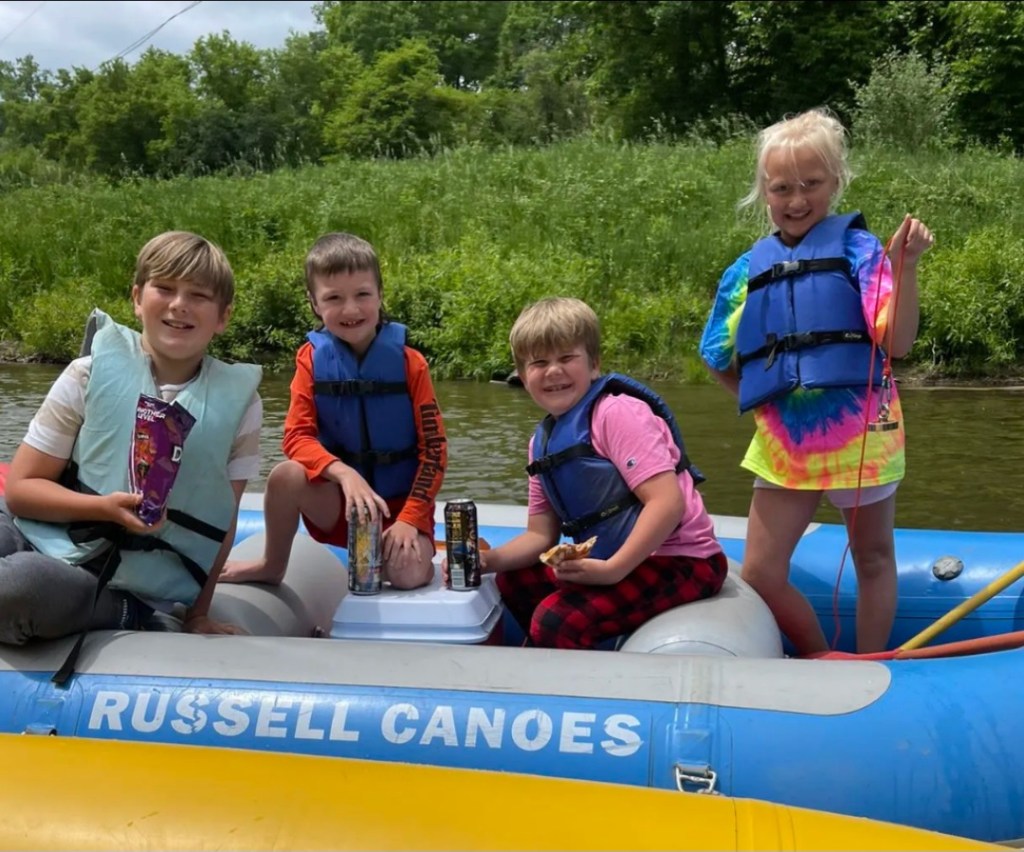
The White family attended as well. White’s Canoe Livery happened to be the first canoe livery on the Rifle. In fact, there would be no Russell Canoe Livery without White’s. My grandfather got the idea from Don White and then started Russell Rent-a-Canoe out of what is now my home. It all started in 1959 with a Ford pickup and a six haul of canoes. To this day, the only person I know who knows the Rifle River as well as my dad is Ladd White, Don’s son and current owner. I hate to think of the knowledge that will be lost when my dad and Ladd are no longer around.
Canoeing near the park in Omer ~ early 20th century. The site of the former Omer park is just downriver from our main location in Omer.
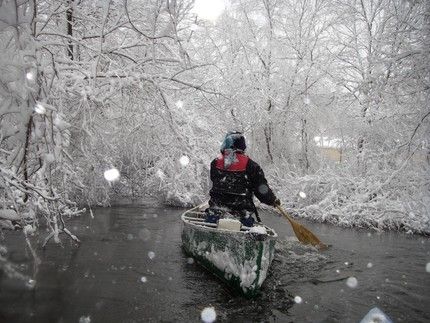
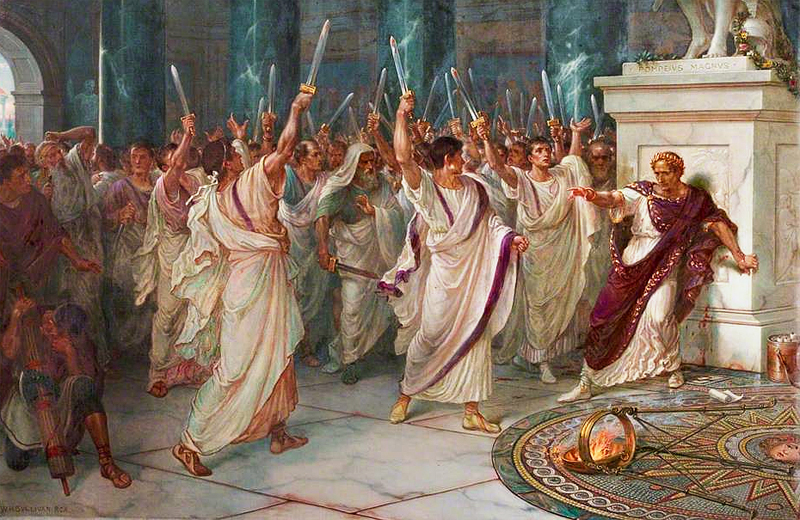
For some reason, I seem to remember that there would be a March canoe trip as part of the meetings. At one point, it may have been referred to as the Ides of March trip. As a child, that fascinated me. I could not understand why anyone would want to canoe in the winter. In my child’s mind, canoeing and tubing meant one thing and one thing only: swimming. What was the point of canoeing if you couldn’t get wet? That happened to be my biggest gripe about March. March supposedly brings spring, and yet, it would be months before I could swim the river again. It didn’t seem fair.
The Rifle River and Russell Canoe Livery will always be a part of me. My first home happened to be near our main location in Omer. One day, hopefully decades in the future, it will also be my last. March is when it all starts to spring to life once again. Reservations start rolling in, plans are made, and merchandise is ordered. I love it all, especially our customers. Here is to a wonderful summer 2024!
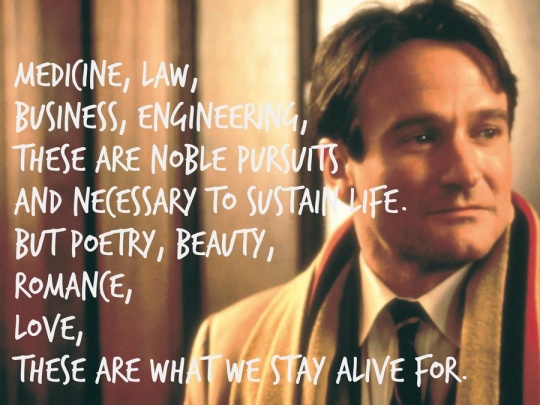
I admit it; I am obsessed with creativity. How do we access it? How do we inspire and cultivate it in others? I am especially concerned about this as a secondary teacher. Over the last several years, I’ve noticed an appalling lack of creativity among students. Many are content simply to move on to the next thing, complete the next step. I particularly saw this during the pandemic. It is what Robin Williams’ character in “Dead Poets Society,” Mr. Keating, discusses in one of his many monologues and develops into a theme throughout the movie, challenging the status quo, not to mention the idea of carpe diem. Ultimately, his students pursuing their passions, against the wishes of their parents, lead to some horrific consequences. While one would hope that such attitudes would have changed since the 1950s setting of the movie, I’m not so sure it has when it comes to education. Unfortunately.
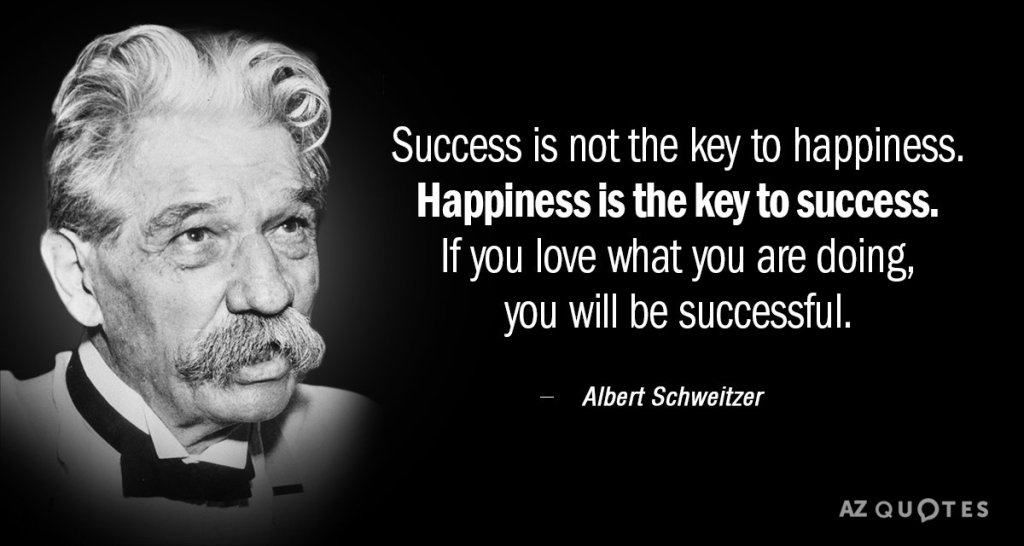
I’m just grateful that I have a creative outlet that I love. Growing up, I loved the art class I took in high school. Sadly, I can’t draw or paint well at all. Yet, I loved coming up with different composition projects in various materials. I can always come up with an idea. Some, of course, are better than others. I also adore art history and find it fascinating. In the end, I wish I had had more confidence in what artistic ability I did have growing up. Who knows where it would have taken me?
Over the last few years, I’ve subbed for an art teacher whom I got to know fairly well during student teaching. I always loved subbing for her. I had fun watching students work on their projects, including ceramics. It made me want a place of my own just to create. I have everything I need, including space. I just need to take the time to make it happen.
What’s sad is that we live in a society that greatly rewards conformity. As adults, we get caught up in work and other obligations. Most of us have precious little time to further develop our creativity. Can you imagine if we did .. or at least valued creativity?
Vitamin C – Graduation (Friends Forever) (1999) (Video)(Lyrics)
(Written February 12, 2024)
I came across the video for “Graduation (Friends Forever)” by accident this past weekend. Sometimes nostalgia slaps you so hard in the face that it cannot be ignored. While I can’t say that “Graduation (Friends Forever)” was ever a favorite, it did leave an impression when it first came out during the spring of 1999. How could it not? I graduated from high school in 1999, and quite frankly, the target audience.
In the midst of watching classic videos from the 80s and 90s, YouTube saw fit to suggest “Graduation.” Thinking “why not?,” I found myself transported back 25 years. What struck me most about the video wasn’t the song at all. Frankly, I still find it way too saccharine. Instead, I thought about how I could have guessed the year from any still photo from the video. Not a cell phone in sight.
It cracked me up. The video definitely fit the late 90s aesthetic that we all thought so bleeding edge at the time. In fact, the girl’s outfit in the video, the layered yellow tank top with the orange/yellow slip skirt, reminded me of one of my go-to outfits in 2001. The only difference? I didn’t layer tank tops. Instead, I wore a jean jacket over a yellow tank top. I remember it vividly because I loved that outfit and that look so much at the time. Maybe it is time to bring it back.
While I can’t say that I loved or even liked high school (I couldn’t wait to graduate and move on), it is fun to look back from time to time. After watching the video, it hit me that this June will mark 25 years since I graduated from high school. How? Just how? Interestingly, “Wear Sunscreen,” a spoken-word release based upon an essay, became popular during the spring of 1999 as well, even though it dates to 1997. See below.
This year will mark my 12th year back working at Russell Canoe Livery. Each year, I love it even more and appreciate what my parents and grandparents built. Without the canoe livery, pursuing my teaching career, and student teaching in particular, would not have been possible. None of it would have been an option. Only when I returned to the family business in 2013 did I fully understand just how much my mom contributed to the canoe livery. After retiring from teaching in 2010, Mom became more involved in the business. Only in 2013 did I begin to take over some of her responsibilities. I had to reconsider what I wanted and the narrative I had created for myself.
Growing up, I always looked up to my dad and Grandpa Buttrick. Both businessmen, I saw how both had created a life for themselves using family businesses. In Dad’s case, the seasonal nature of the canoe livery allowed him to pursue other interests and provide us with a great quality of life. As his sidekick, I grew up watching Dad making decisions about the business. Prior to building the Crystal Creek shower house in 1992, I went with him to check out similar showerhouses. One of my earliest memories is going with Dad in his truck to unclog the artesian well across the road in Crystal Creek Campground. I used to argue with him when Erica and I would catch the bus from our house behind Crystal Creek to our main location in Omer. He, of course, wanted us to ride in his bus. Knowing that he wouldn’t let me bounce around in the back of the bus, I wanted to ride with anyone else. Dad often won.
Grandpa Buttrick, on other hand, moved his young family from Marshall, Michigan to Standish, Michigan to take over his grandfather’s business: Forward Corporation. On our yearly trip to the Upper Peninsula with my Buttrick grandparents and cousins, we always had to stop in Gaylord to check on his convenience stores. He loved the business, and due to a unique set of circumstances, I managed one of his convenience stores for a few years. Through that experience, I learned just why he loved that business so much. If I hadn’t moved back to Michigan in 2005, I would not have had the opportunity to get to know Grandpa Buttrick so well before he passed away in 2007. Like teaching, business runs deep in my blood.
Late 90s at Russell Canoe Livery. Hard at work!
When I graduated in 1999, I attended Michigan State University to pursue a business degree in supply chain management. I quickly decided to pursue a Spanish degree too. I couldn’t give it up. Both of my older cousins earned degrees in supply chain management from MSU as well. I knew the program, and frankly, the subject still fascinates me. Even though I didn’t end up with a long career in supply chain, those experiences during my years at MSU made a deep impression on me and still shape how I view the world.
The processes of working so closely with my parents on all things relating to the canoe livery and establishing my teaching career gave me a whole new appreciation for my mom. I will never understand how she taught kindergarten for 15 years. Two half-days substitute teaching in kindergarten were more than enough for me.
As time went on, I slowly realized that the canoe livery would not have been nearly as successful without Mom and Grandma Reid. Dad may have had the vision and made it happen, but it would not have been possible without great customer service provided by us all. I may have grown up wanting to follow in Dad and Grandpa Buttrick’s footsteps, but I followed in my mom’s instead. I just faced a different set of circumstances.
Toby Keith – Beer for My Horses (Featuring Willie Nelson) (2003) (Video)(Lyrics)
Written February 10, 2024
Toby Keith. I can’t help but feel that his death is the end of an era. The lyrics to “Beer for My Horses” have been running through my head ever since I learned of his untimely death early Monday morning. Even though I’ve never truly been a full-fledged country music fan, I loved most of his music. What I don’t love, I simply haven’t discovered yet. While my heart will always belong to pop/rock, alternative, classic rock, etc., Toby Keith will always remain one of my favorite country artists. Songs such as “I Love This Bar,” “Courtesy of the Red, White, and Blue,” “Should’ve Been A Cowboy,” “Whiskey Girl,” “American Soldier,” and so, so much more were always a part of the soundtrack to my college years and early 20s. I don’t think it is possible to even discuss popular music in the early 2000s without mentioning Toby Keith in some form, and that isn’t even considering his lasting impact on country music.
So, what is it that made him so popular and memorable? Personally, he always reminded me of the older brothers of classmates. The ones that were either too cool or cautionary tales, depending on your perspective. Those with just a hint enough of danger to make them attractive. He never cared what others thought, and he never shied away from his rural upbringing. In fact, he celebrated it, and we loved him for it. In spite of everything, he remained true to himself and wasn’t afraid to celebrate his love for his country. All of that resonated with me and so many others.
By the way, if you haven’t watched the video to “Beer for My Horses,” check it out. It is even better than I remember.













 Ramblings of a Misguided Blonde