Category Archives: writing tools

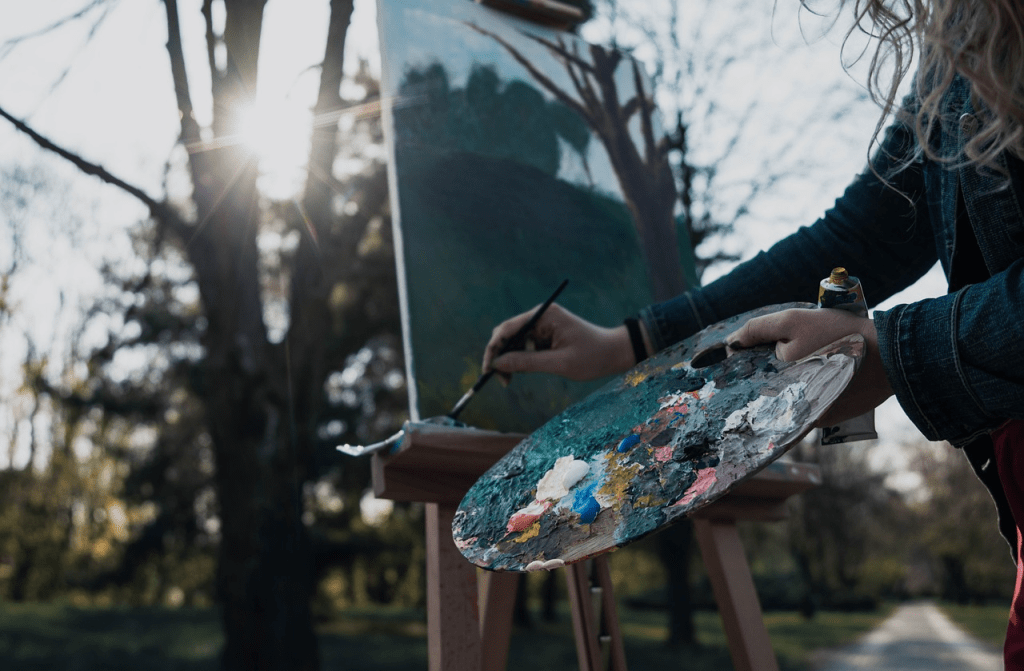
Creative Space

One of my biggest projects this school year – so far – is to establish a creative writing club for our high school.  I started with a vision and my previous experience of working with my teacher bestie, Dorri, to start a writing club at my previous school.  To say that I learned from that experience is an understatement.

In that club Dorri and I worked to establish at St. Michael School, we dealt with technology issues, age differences (serving young middle grade students as well as middle school students), not to mention the hazards of the COVID 19 pandemic.  It is crazy to think that we achieved anything at all.  Yet, we did in a small way, even if the larger St. Michael community didn’t always recognize it.

We may have had a small core of roughly half a dozen students, but they were truly interested.  They eagerly learned from one another.  My 7th and 8th students demonstrated patience with Dorri’s 3rd graders, many of whom were just learning how to more fully express themselves in writing, expanding their thinking along with their vocabulary.  Dorri’s 3rd graders brought enthusiasm and fresh perspectives to their older peers’ projects.

When I started at Michigan Virtual Charter Academy this past fall, I knew that I wanted to become involved in some kind of club.  While I knew that we had a well-developed esports program, I didn’t exactly know what other clubs were offered.  It turned out that while we offer an academic creative writing class, we did not have a creative writing club.  Well, I sought to change that.  So far, I have succeeded.

At the beginning of the school year, I focused on creating an online classroom full of resources I could have only dreamed of as a high school student in love with writing.  There are dozens of websites to explore, hundreds of writing prompts, inspiring quotes, book recommendations, and so much more.  Then, I watched over several weeks as my students connected and explored common interests.  They grew as writers and found the confidence to share their work and a little bit about themselves.  Students then spent much of the semester writing pieces intended for eventual publication, likely a blog.  What happened next, I did not see coming.

We may have to wait until next school year to publish anything, but not only are both the  principal and assistant principal extremely supportive, our head of school now knows about the project.  In fact, I’ve received nothing but positive feedback.  Right now, I am working on helping to ensure we keep moving ahead in the right direction.  Who knows where this will take us?  Already, I have had two new club members join in the first few weeks of this new semester.  They’ve fit in seamlessly, which is a testament to the culture my students created.  I am incredibly proud of what they’ve achieved!
November 1st – Happy National Author’s Day!

I just found out today is National Author’s Day. How appropriate!  The creative writing club I started at school met this afternoon at the end of the school day.  There is never a dull meeting.  They are so passionate about their interests, including but not limited to writing.  I’ve watched as members have bonded over music and other media.  It is inspiring how they support one another, too.

In the online school environment, there aren’t quite as many opportunities to strike up friendships with classmates as in brick and mortar.  Personally, I think that is why school clubs are so vital in an online school environment.  Last year, my first year teaching online, I watched as students planned for weeks and even months for the in-person prom held at the Lansing Center.  Students attended from all over Michigan. The pictures, conversations, and friendships made that evening were discussed repeatedly as the school year came to a close.  I can only hope that that same can be said when I reflect on the creative writing club at the end of the school year.

In my first year as mentor and creator of the club, I sought to find the best possible resources for aspiring high school writers.  Luckily, my online classroom set aside for our new club allowed me to do just that.  It is now a place where students can collaborate, offer one another and seek encouragement, as well as find resources and inspiration.  I can only imagine if I had had such a resource in high school.  I admit, I’ve had too much fun setting things up.  So far, my entire experience with the creative writing club has underscored the importance of community as a writer.

Face it:  Writing can be lonely work.  Over the years, I’ve always enjoyed meeting other writers.  I can’t imagine where I’d be as a writer without Mid-Michigan Writers.  I’ve learned so much from other members over the years, and I would not have discovered Delta College’s general writing certificate program if I hadn’t attended MMW’s Gateway to Writing workshop with other writers who raved about the experience.  If my students take away anything from our creative writing club, I do hope that they realize the importance of community for writers.  Brainstorming works best with others!  At some point, we could all use a second opinion.  We all have to learn from someone.  I can’t imagine not having my very own community of writers and readers. Happy National Author’s Day!

Oh, and happy first day of NaNoWriMo. IYKYK.

The Writing Life – Act Two

I don’t understand.  I adore writing, and I have no shortage of material.  In fact, I came across my blogging notebook today.  Page after page full of great ideas I have not yet written.  I also came across another binder of writing projects, as well as my writing portfolio from one of my favorite writing classes, a class I took at Delta College nearly a decade ago.  What to do with it all?  It is time to bring it all together.  Why is it so difficult for me to write consistently for long stretches of time?  Why did I abandon poetry again?  I came across some wonderful pieces.  Pieces that need a home.

Then there are the larger projects.  Mom and I need to finish her series of children’s board books, abandoned nearly nine years ago.  I still love them.  Over the last several years, I’ve toyed around with the idea of writing a book about the canoe livery.  It is time to put in the research.  I need to interview my parents and former employees before it is too late.  I do not want those stories to be lost, even if they are never published.  There are simply too many good ones.

So, what is getting in the way?  Quite simply, life.  Accepting a position as a 10th grade English teacher at Michigan Virtual Charter Academy (MVCA) back in August, I’ve been busy.  While I subbed at MCVA most of last school year, I am now a full-fledged faculty member who hadn’t yet experienced the start of the school year – and all that brings (I started in early October last year).  In other words, I’m now getting back to finding time to write.  Just because you have prepared for a new school year in a brick and mortar school does not mean that you know the ins and outs of preparing for a new school year at a virtual school.

One highlight of the school year is creating an official high school creative writing club.  I am passionate about it.  So far, I’ve been able to create a safe online space for students interested in creative writing.  As a club, there are no academic expectations.  We are writing for the sheer creative power of it.  By the way, MVCA offers a creative writing course as well.  This … this is something different, something special.

Thus far, I’ve curated websites that might help budding high school creative writers.  I’ve also shared my favorite quotes and books on writing.  There is space for students to share their work amongst themselves.  I can’t imagine what I would’ve done with those resources, all online and free, and such a nurturing community.  The best part is the enthusiasm of my students.  I’ve watched them form fast friendships over favorite music, video games, books, movies, and more.  They are so supportive of one another.  I can’t wait to see all that we will accomplish this year.  That includes getting back to my own writing.

Author Profile: Anne-Marie Oomen

Michigan author Anne-Marie Oomen visited Saginaw Valley State University
and the surrounding area in April.

Anne-Marie Oomen

I am ashamed to admit it, but I have yet to fully read one of Anne-Marie Oomen’s memoirs or books of poetry, even though I own two of her books (signed) and have attended a couple of her writing sessions (one for teachers and other, this past spring, open to the general public), as well as a reading from her latest book, As Long As I Know You:  The Mom Book.  I’ve only read and heard snippets of her work … so far.

What I’ve read and heard thus far is wonderful, and knowing the topics/subjects/genre included in many of her books, I know that I will love them.  How could I not purchase a book titled Love, Sex, and 4-H?  Then there is As Long As I Know You:  The Mom Book.  I can’t wait to read it.  The passages that she read during her author event, along with the anecdotes she shared about herself, her mom, and writing the book, definitely left me hooked.

What I really want to discuss today is her capacity as a teacher.  Just over a month prior to the shutdown orders signaling the official start of the pandemic, I had the opportunity to attend a day-long writing program aimed at teachers.  Titled “Homecoming:  Coming Home,” it was sponsored by the Saginaw Bay Writing Project.  Anne-Marie Oomen happened to be one of the presenters that morning.

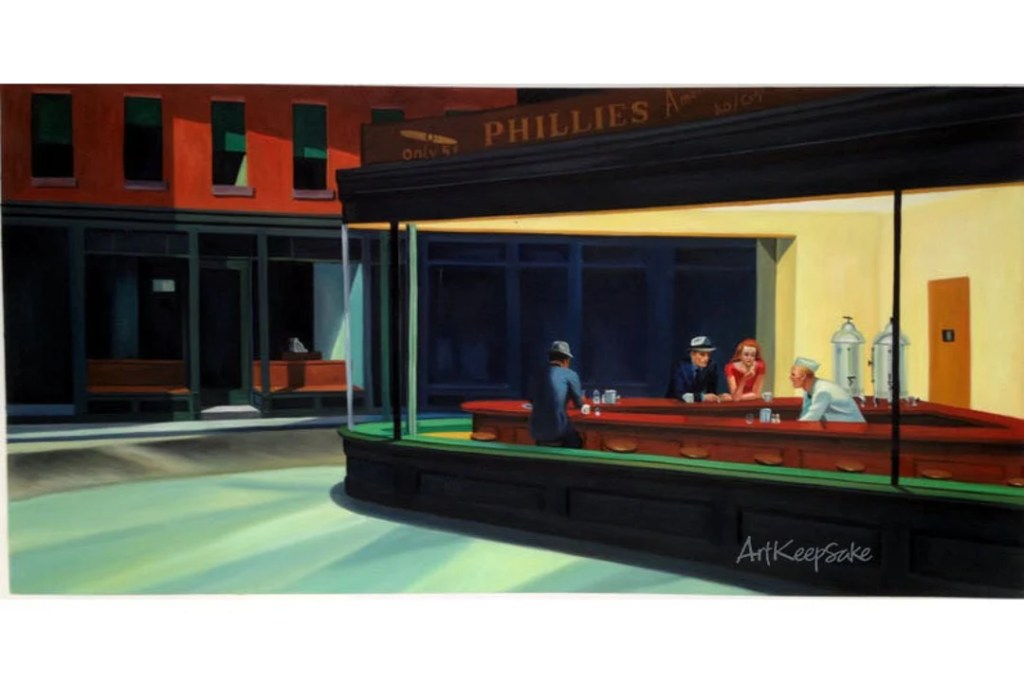
During her allotted time, she taught us the term ekphrasis – a method of using different works of art to create various forms of writing, whether poetry, personal essay, or short story.  Imagine studying a painting and then creating a poem from your experience.  That is ekphrasis.

After explaining the process and providing us with examples of her own work, Anne-Marie Oomen had us create our own art inspired piece.  She brought with her a large collection of postcards.  I chose one with a portrait of Annie Oakley on the front, “little sure-shot.”  I enjoyed the experience and still have a digital copy of her presentation from that day.  I left realizing that I could easily create vision boards on Pinterest to gather my thoughts and ideas for various writing projects.

Anne-Marie Oomen used the painting Nighthawks by Edward Hopper
to demonstrate the process of ekphrasis.

As wonderful as that experience was, a few months ago I learned that Anne-Marie Oomen was to be a guest scholar at Saginaw Valley State University.  During that time, she conducted a similar writing session open to the general public at the Marshall Fredericks Museum on SVSU’s campus.  I am so glad that I attended.  It made me look at one of my favorite museums in an entirely different light.  I left with a notebook full of ideas and even a rough draft.  The following evening, Anne-Marie Oomen held a reading at the Wirt Public Library in Bay City, sharing snippets from As Long As I Know You:  The Mom Book.  I’m so glad that I attended as it brought back so many memories of the short few months I had living with Grandma Reid before she needed more care than I could provide.  It is never easy watching someone you love age and decline.

I took something away from each of Anne-Marie Oomen’s events.  On top of sharing her love and knowledge of writing, she is a wonderful teacher.  Better yet … she is a Michigan author willing to help aspiring writers and teachers.

Anne-Marie Oomen’s latest book As Long as I Know You: The Mom Book details her experience dealing with her relationship with aging mother.

Reading Inspiration for Writers – Part 2

As with so many writers, I fell in love with reading first.  Over the years, I have found my reading life crucial to my continuing education as a writer.  The best writing advice I’ve ever received is to read as widely as possible.  The best part:  Most of the tips, resources, and suggestions I am sharing here are little to no cost.  One crucial requirement:  a library card.

The following is a continuation of the list I started in Part 1.  You can find it below.

Reading Inspiration for Writers – Part 1

Join Book Clubs

I currently belong to three book clubs, and all three serve different roles in my reading life.  First, as a writer, I would encourage you to join a book club similar to Mid Michigan Writers’ own Scribblers and Scholars.  We meet every-other month to discuss books from the point of view of writers.  Lately, we’ve been working on comparing Educated by Tara Westover to The Glass Castle by Jeanette Walls.  Scribblers and Scholars aims to provide writers with a book club focused on dissecting the craft of writing, although we tend to discuss just about anything related to the books.

I’ve also belonged to the Standish-Sterling Book Club for years.  It is the first formal book club I’ve joined, and while we certainly discuss the books we picked, there is an in-person social aspect to the club that I love.  In fact, two of my former teachers also belong to the club, both of whom have had a profound impact on who I am today.  We meet monthly, and there is truly no judgment if you don’t quite finish a book that is less than thrilling or if you can’t make a meeting.

Last but not least, I’ve also joined the Spartan Book Club, which resides entirely online, as an alumni of Michigan State University.  In fact, it has its own forum and much more.  Books are selected quarterly, and once again, members are free to participate as much or as little as you’d like.  I’ve met some wonderful people online and have thoroughly enjoyed the book selections.  I’ve also used the Spartan Book Club for reading suggestions, as there are also several wonderful books mentioned not chosen as a book club selection.

I mention all of my book club experiences because they demonstrate that there is one out there for every type of reader.  As a writer, all of my book club experiences led me to books I would not have picked up otherwise.  I am a better writer for it, and it provides yet another outlet in which to discuss books.  Think about what you would like out of a book club, and with a little research, you will find it.


Embrace eBooks

If you haven’t discovered the benefits of ebooks yet, here are a few things I’ve noticed as a writer.  First, I tend to be a collector.  I intentionally collect certain books, hopefully to be read more than once.  While there is nothing quite like the smell of a good book, collecting hundreds of ebooks takes up a lot less space in my home.  Second, with Kindle, my preferred ereader and type of ebook, I can have my entire ebook library not only on my phone, but on my Chromebook and Kindle Paperwhite as well.  Last but not least, I have a hard time highlighting or writing in traditional books.  Ebooks allow me to highlight and make notes to my heart’s content without marking up a traditional book.  My notes and highlights are waiting for me when I return.

Ebooks tend to be more cost effective as well.  Often, the Kindle version is less expensive than either paperback or hardcover.  While the prices of Kindle books are rising in some cases, there are also several websites and offers for free or low-cost Kindle books.  BookBub is one of the best.  I actually had to quit because I found too many great free books.  It became overwhelming.  Of course, libraries are increasing their access to ebooks as well.  The beauty of ebooks from the library is that, not only is there no cost, you don’t need to physically visit the library or remember to return the book either.

Research and Read Book Reviews

There are countless places to find good book reviews and research book suggestions.  Goodreads has everything and provides access to all kinds of reviews.  Personally, I enjoy book blogs.  My favorite is Modern Mrs. Darcy.  She has it all:  endless book lists, audiobook recommendations, her own book club, a podcast, and so much more.  If you are into the reading life, you need to check it out.  It might take some research, but once again, there are book blogs and review sites aimed at every type of reader.  It is a matter of finding your niche.

Take a Class

I admit, pursuing my English Language Arts (ELA) endorsement in secondary education (grades 6-12) forced me to branch out as a reader.  I’ve learned so much from my formal writing and literature courses.  Yet, it isn’t necessary to spend hundreds or even thousands of dollars on tuition to take a literature class.

Two trusted, established sites I’ve used in the past are Coursera and Canvas.  While I haven’t taken writing or literature courses specifically on either site, I do know that they are readily available at little or no cost.  Other courses I’ve taken on those sites, mainly on educational technology, have been wonderful.  On the clearinghouse site ClassCentral, a quick search under literature resulted in free survey courses offered by the likes of Harvard and the University of Pennsylvania on a wide variety of subjects relating to all aspects of literature.  You can find my search result here.  There is also The Great Courses Video BingePass available on Hoopla that allows patrons access to the The Great Courses Video Collection for free for a week.  The possibilities are endless.

Curate Your Own Lists of Books/Literature

Of course, there is always the DIY approach.  Take the time to make your own lists of books and other forms of literature that interest you.  I’ve made several of these lists over the years, and it helps me keep track of things that I came across years ago.  I’ve found creating lists of authors and major works to be helpful.  Make the list you are seeking if it doesn’t quite exist yet – and have fun.

Reading Inspiration for Writers – Part 1

As with so many writers, I fell in love with reading first.  Over the years, I have found my reading life crucial to my continuing education as a writer.  The best writing advice I’ve ever received is to read as widely as possible.  The best part:  Most of the tips, resources, and suggestions I am sharing here are little to no cost.  One crucial requirement:  a library card.

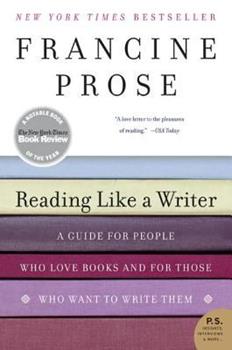
Read Reading Like A Writer by Francine Prose

I read Reading Like A Writer well over a decade ago, but it is one of those books that never left me.  I can’t recommend it enough for any writer.  Prose makes the case for reading widely and for looking carefully at the literature you love most.  Ask yourself:  Why do I love this particular author?  Why do I keep coming back to this particular genre, series, or author?  What techniques is the author employing to keep readers interested?

There are endless opportunities to learn the craft of writing by reading if we know what questions to ask.  Bonus:  The reading list Prose includes for writers is wonderful.

Make Use of Your Local Library and Get to Know Your Local Librarians

A library card is a no brainer.  These days, I tend to use mine to discover and borrow audiobooks via the service Hoopla, as well as borrow ebooks for my Kindle.  Yes, I still checkout traditional books from time to time.  The advantage to ebooks, including Kindle books, and anything from Hoopla is the simple fact that it isn’t necessary to visit the library at all.  It is easy to borrow them online.  Once they are due to be “returned,” the borrower simply no longer has access to the book.  If not quite finished, readers may be able to renew online, depending on the popularity of the book.

Over the years, librarians have been extremely helpful.  As an English teacher during the COVID 19 pandemic, I was fortunate to have local dedicated librarians who were willing to Zoom with my English classes in order to teach students how to borrow books digitally.  Once restrictions were lifted, those same librarians helped me prepare a “book tasting” for my classes in an effort to help students figure out what genres they might enjoy.  As a patron, if you ask, a librarian will nearly always be able to at least point you in the right direction.  They, indeed, should run the world.

As a writer, if you find yourself in a rut in your reading life, there is no better place to seek inspiration than the library.  I’ve been known to take pictures of the covers of books I find interesting in order to add them to my to-be-read pile later.  At times, just the creative grouping or display of books at the library is enough to spark ideas.  If nothing else, pick up a copy of the magazine BookPage to find out what’s new.

Utilize Audiobooks to Energize and Expand Your Reading Life

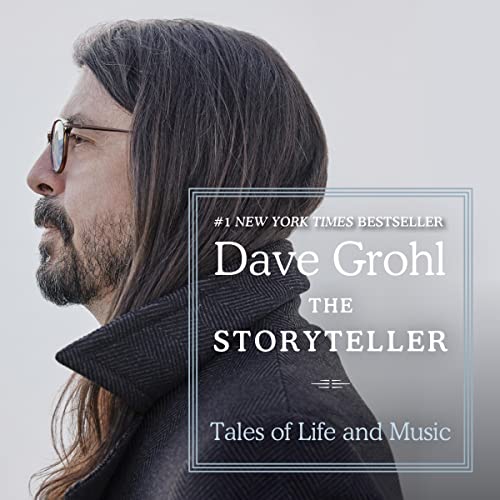
Sometimes, a book is just better via audiobook.  I admit, I was skeptical.  It felt like cheating.  Frankly, the book Confessions of a Prairie Bitch by Alison Arngrim changed all that.  As a fan of both The LIttle House on the Prairie book series and TV show, I knew that I didn’t want to miss Nellie Oleson herself reading her memoir.  I was not disappointed.  Currently, I am listening to The Storyteller by Dave Grohl.  It is another example of the audiobook format being well worth it.  Right now, with audiobooks, I am focusing on memoirs read by their authors.  It seems a natural fit.

Personally, between work and school, I drive quite a bit.  As much as I love listening to the radio and music, audiobooks are a great way to make the most of my time in the car.  It gives me more time to devote to books, which is always a good thing.

Catalog – and Share – Your Reading Life

Before there was Goodreads, there was LibraryThing.  While I have used other benefits of LibraryThing over the years (I am a lifetime member), it offers a way to easily catalog your collection of books or simply track your reading.  Similar to Goodreads, LibraryThing also connects communities of readers.

Sadly, I don’t use either website to track my reading as I am trying to come up with a good system that I will continue to use.  However, both Goodreads and LibraryThing are both excellent ways to find new titles, connect with other readers, read book reviews, and so much more.

Personally, one of my favorite annual features of LibraryThing is SantaThing during the Christmas season.  After choosing a participation level between $20-$50, someone else in the LibraryThing community is tasked with finding books for you to enjoy within that dollar amount.  As a participant, you get to pick for others.  Fortunately, there is a form to fill out that helps avoid duplicates, detail favorite genres/authors, and more.  It is fun to both pick out books for someone you don’t know and see what others have selected for you.  I have participated for several years at this point, and I have yet to be disappointed.  I view it as an annual birthday/Christmas present to myself.  It is yet another way in which I’ve come across wonderful books I would have never picked up otherwise.

Sharing books is equally important.  Frankly, I can’t imagine my reading life without having opportunities to share what I’ve read with others.  I’m fortunate to have grown up in a family that shared and discussed books.  Today, I share book reviews on my blog, Ramblings of a Misguided Blonde, and I still share my favorites with family and friends.  Beware, I tend to review books I love.  I rarely write a negative book review as I can think of only one exception.

Stay tuned for Part 2!

Interview with Mari L. McCarthy

HYSWJP Bronze

Today I am happy to share an e-mail interview with Mari L. McCarthy.  It is all about the power of journaling!  Check it out below:

  1. Why did you decide to start journaling in the first place?

It was for physical therapy purposes only.  I had an MS episode where I lost most use of the right side of my body, and I needed to teach myself how to write with my left hand ASAP.

  1. When did you notice a connection between journaling and how you felt physically, spiritually, and mentally?

Right away.  I got started with Julia Cameron’s Morning Pages, and the three stream-of-consciousness pages first thing every morning took me on a magical mystery tour.  I started hearing rhymes and started writing poetry for the first time in my life.  And, I started remembering things from my childhood 60 years ago and experiencing it as if it was happening right now.  I was able to process the events through the pages, became aware of how many erroneous thoughts and feelings I was carrying around in my body, and created new thoughts that reduced all kinds of mental, physical and spiritual stress.

  1. Who do you think could benefit most from journaling daily?

Everyone.  We all have had challenging childhoods where we just sucked in everything, including a lot of erroneous thoughts and feelings (I call them issues in our tissues). Journaling provides us the opportunity to understand the origins of our crazy thinking and shows us how to reframe our thought process.

  1. What advice would you give someone who is just starting on their journaling journey?

Journaling is about facing our fears, learning how to manage our negativity and inner critics, and reclaiming our power.  That is monumental behavior change.  Take it easy.  Journaling is about thinking with your heart and soul.  Our overanalytical head has been in change for so long she’s afraid of losing control.  My recommendation is to ask your journal a question and then free-write fast until you feel – my favorite 4 letter F word – like stopping.

  1. What do you think is the biggest roadblock for those who want to make journaling a daily habit and fail to do so?

We are our biggest roadblock.  We are experienced in self-sabotage and in having an unhealthy relationship with ourselves.  Fear has controlled us since forever, and it is scary and a lot of hard work to explore our inner world.  Plus, we were raised to think that alone time is so selfish.  It is a totally new experience to work through the pain and heal our wounds.

journal 3

  1. Do you prefer to handwrite or type your journal entries?  Which would you recommend to those new to journaling?

Pen to paper every day is the only way to get all the physical, mental, emotional and spiritual health benefits that are available to you from journaling.  Jumping right in and freewriting is a good start.  Make sure you breathe and understand that your head (ego, inner critic, other voices…) will go crazy.  Writing fast will show them you are in charge.

  1. Why do you think journaling has such a profound effect on our lives and how we perceive ourselves?

 I don’t know.  I can only tell you that I have monumentally healed, grown and transformed myself thanks to journaling.  I live a compassionate (!) unconditional love-in with myself, and it grows every day.  In my first book, Journaling Power: How to Create the Happy, Healthy Life You Want to Live, I have results from scientific studies that are researching and monitoring this magical, mysterious self-healing process.

  1. Aside from journaling, how else do you think writing can help us lead better lives?

Writing is creative self-expression, and we have so much inside of us that we’ve been stuffing down for so long.  Writing is giving ourselves permission to be the truly talented (wild and crazy) person we are and share our brilliance with the world.

  1. What do you think we as writers can learn from our journaling patterns (i.e. the topics we keep coming back to time and time again)?

Besides the therapeutic value journaling has, it gives us great ideas for poetry, essays, characters for fiction writing.

  1. Aside from journaling, what advice would you give readers eager to live their best lives?

Carve out “ME” (self-care) time every day where you can just be with yourself.  We’re great doers and care takers and fixers and…. What we need to do is put ourselves first and work on reconnecting and staying connected to our true self every day.

Mari, thank you for sharing such great advice and insight with my readers!  Best of luck with the rest of your blog tour.

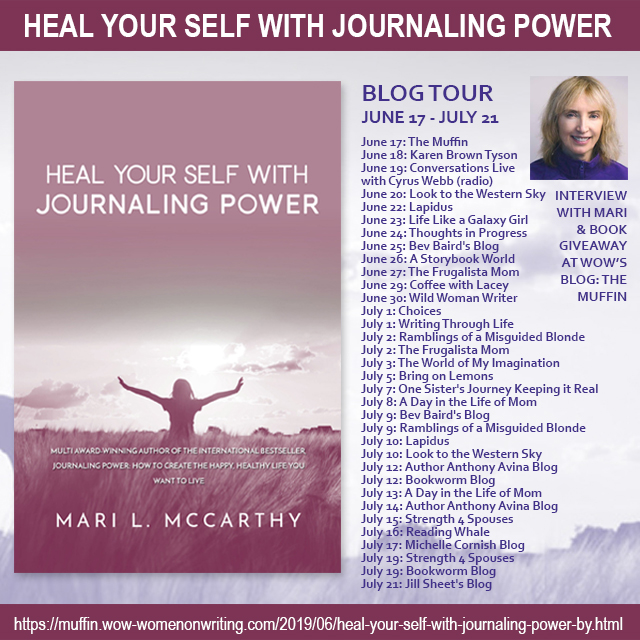
Banner-HealYourSelfWithJournalingPower-MariMcCarthy-BlogTour

Book Review: Heal Yourself with Journaling Power by Mari L. McCarthy

HYSWJP Bronze.jpg

In Mari L. McCarthy’s latest book Heal Yourself with Journaling Power, she outlines the many personal benefits of starting or continuing to journal.  Heal Yourself with Journaling Power offers writers and non-writers a concise overview of how journaling can be used to help resolve all kinds of personal issues through daily journaling.  The book itself serves as a roadmap and call to action for anyone desiring change or left wanting more out of life.  I expect nothing less from the author/creator behind CreateWriteNow.

Mari begins by describing the true power behind journaling:  daily habit.  It did not surprise me that she begins by mentioning morning pages.  The same concept fuels one of my favorite websites:  750words.  Deceptively simple, the humble act of writing daily drives later change.  Once journaling becomes a daily habit, the real work begins.  However, all true healing through journaling hinges on writing consistently.

In the book, Mari provides readers with an outline on how to use this power to heal their own lives.  She includes different aspects of her personal story and anecdotes of others who have had similar experiences to drive her points home.  In addition, she provides readers with journal prompts in each chapter.  As a result, it can easily be viewed as a textbook by anyone wanting to use journaling to fundamentally change his or her life.  Part memoir, part writing manual, and part self-help book, I would recommend Heal Yourself with Journaling Power to anyone remotely interested in self-improvement, journaling, or writing generally.

In fact, a few simple tools will put anyone on the path to healing through journaling.  Personally, I would recommend using 750words or another online journal to get started journaling daily.  Add in the community and resources over at CreateWriteNow along with a copy of Heal Yourself with Journaling Power to keep motivated and moving forward.  I don’t see the need for much else when it comes to journaling, although different prompts are always fun and often provide insight that moves the process along.

As a writer, I found myself largely agreeing with Mari throughout the book.  While I haven’t experienced some of the more dramatic physical changes she attributes to journaling, I have journaled consistently enough during various stages of my life to attest to its power.  I particularly agree with Mari that journaling provides a clarity that is difficult to find anywhere else.  The clarity that comes from journaling consistently can help writers overcome a myriad of obstacles that may be in their way, no matter what they might be.

While I would recommend Heal Yourself with Journaling Power to any writer, non-writers may benefit from it message to a greater degree.  The techniques outlined in the book can be used by anyone to help identify roadblocks and move forward on any goal, dream, or ambition.  Using the journaling process to help organize one’s thoughts and formulate a plan of action may not be obvious to non-writers.  The power of journaling needs to be experienced to fully understand just how lifechanging it can be.

Stay tuned!  Next week I will be interviewing Mari L. McCarthy.

Banner-HealYourSelfWithJournalingPower-MariMcCarthy-BlogTour.jpg

About the Author, Mari L. McCarthy

Mari L. McCarthy is the Self-Transformation Guide and Founder/Chief Inspiration Officer of CreateWriteNow.com. She is also author of the international-bestselling, award-winning book Journaling Power: How to Create the Happy, Healthy Life You Want to Live.

Mari began journaling to relieve the debilitating effects of multiple sclerosis (MS) over 20 years ago. Through journaling, Mari was able to ditch her prescription drugs and mitigate most of her MS symptoms. Now she teaches people throughout the world how to heal, grow, and transform their lives through the holistic power of therapeutic journaling.

She lives in a gorgeous beachfront home in Boston, where she has the freedom, flexibility, and physical ability to indulge in all her passions, which include singing and recording her own albums.

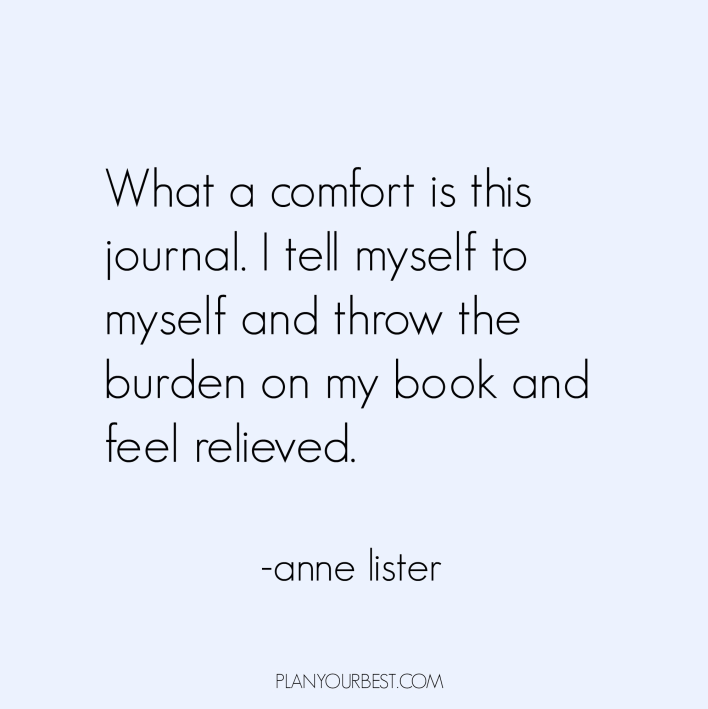
Journaling Quote

Writing Unleashed

Writing.jpeg

I’ve discovered so many great books and resources on writing lately.  I would share them with you here, but there are too many.  I’ve come to the conclusion that I need to share them here separately, such as my post yesterday on Scrivener.  That way, they can all be linked via tags. Also, I do plan to write a few pieces for other blogs covering similar topics, so stay tuned.  As soon as they are published, I will link them here.

So why am I so fascinated with discovering new books on writing and writing tools? Well, I am continually seeking to become a better writer.  That is why I write.  I do have something to say, and when I finally start working seriously on something for publication, I want to be the best that I can be.

So, here is what I have learned so far:

  1. Famous books on writing are famous for a reason.  They are worth your time.  I have yet to be disappointed.  If you are looking for a place to start, this list should do it.  I am slowly working my way through it.  There is always something to learn.
  2. The online writing tools out there today offer something for every type of writer.  Do your research and choose wisely.  So many great things to try out!  It might take you some time to figure out what works for you, and that’s OK.  If something isn’t working well, see if you can find something better.
  3. It is fun helping others who love to write.  Seriously, I love to help, and it is great motivation for me to keep going.  If someone discovers 750 words, Scrivener, or On Writing by Stephen King thanks to my recommendation, all the better.  There is room for everyone.  My ideas are not your ideas, etc.  That, for me, is the beauty of any art.
  4. Writing groups – and critique groups in particular – are invaluable.  Any feedback I get from Mid-Michigan Writers is great.  Even if I decide not to use it, it alerts me to other ways of viewing my work.  As writers, we are too close to our own work.  No matter how perfect a piece may seem, there is always room for improvement.  Just being around other writers and discussing all things writing is priceless.
  5. There is always something else to learn.  This goes along with the fact that all writing – and I do mean all – can be improved.  Start with your interests and see where it takes you. If you get stuck, start researching, whether subject or genre.  It doesn’t matter much.  See what else is out there.  You will discover something.

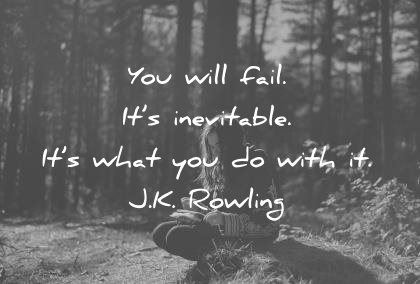
JK Rowling Writing Quote.jpg

The more I learn about writing, the more I wish ELA (English Language Arts) curriculum spent more time on creative writing.  Plenty of instruction on how to nail those high school and college essays, but little in the way of creative writing instruction.  It is true now, and it was true twenty or even fifty years ago.  If writing were a separate subject in the high school curriculum, that certainly would have been my focus.  Sadly, creative writing courses are only offered at the college level (usually) – and many college students can’t find a way to fit it in due to either lack of time and/or money.  Notice I did not say lack of interest.

I only had the opportunity to pursue a general writing certificate program at the community college level due to the fact that I learned about the program thanks to a writing workshop and the fact that I was already taking classes there for my teaching certificate.  I loved my experience, and in some ways, I wish I could go back and complete some assignments as a more seasoned writer – my portfolio for one class in particular.  I know I’ve grown as a writer; I also realize I have a long way to go.

Your Story.jpeg